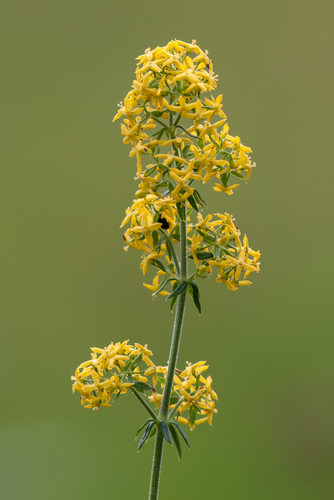
Lady's Bedstraw
Galium verum
Transforming meadows into golden carpets, Lady's Bedstraw is a fragrant perennial that brings a touch of ancient sunshine to your backyard. Known for its honey-scented blooms and historical role in cheesemaking, it is a must-have for attracting rare pollinators.
Quick Identification
Size
Height ranges from 15–60 cm (6–24 inches); spreads horizontally to form dense mats up to 1 meter (3.3 feet) wide.
Colors
Bright lemon-yellow blossoms in dense clusters; foliage is a deep, dark green.
Key Features
- Dense, froth-like clusters of tiny yellow flowers
- Whorls of 8-12 narrow, needle-like leaves
- Distinctive sweet, honey-like fragrance
- Square-shaped stems that are slightly hairy
When You’ll See Them
Behavior
Lady's Bedstraw is a hardy perennial that thrives in low-nutrient soils, often forming golden blankets across meadows and coastal dunes. It is famously known for its sweet scent, which intensifies when the plant is dried. Historically, this fragrance made it a popular choice for stuffing mattresses—hence the name—as the scent helped repel fleas and provided a pleasant aroma for sleeping.
Ecologically, this plant plays a vital role as a nectar source for a variety of pollinators. It is particularly noted for attracting the Hummingbird Hawkmoth and serving as a primary food plant for the larvae of several specialized moth species, such as the Gallium Carpet moth. Unlike its cousin, Cleavers (Galium aparine), Lady's Bedstraw does not 'stick' to clothing, making it a much more welcome guest in managed backyard wildflower patches.
EverydayEarth exclusive
Camera Tips
Capturing the beauty of Lady's Bedstraw requires a different approach than fast-moving fauna. Because it is a stationary target, it is an excellent subject for testing your camera's macro capabilities and time-lapse settings. Position your camera on a low tripod or ground mount, focusing on a dense cluster of yellow blooms. If your AI camera features a 'macro' or 'near-focus' mode, ensure it is activated to capture the intricate details of the four-petaled flowers.
To capture the wildlife that Lady's Bedstraw attracts, set your camera's trigger sensitivity to high. This plant is a magnet for the Hummingbird Hawkmoth, which moves with incredible speed. Using a fast shutter speed or 'burst' mode will help freeze the motion of these hovering visitors. Since the plant's fragrance peaks in the late afternoon, this is the prime time to catch pollinator activity. Use a side-lighting angle during the golden hour to make the yellow froth of the flowers appear to glow against the green foliage.
For a truly unique perspective, use a time-lapse setting over a period of 12 to 24 hours. This allows you to observe how the plant reacts to the sun and the wind, and how different insects visit at different times of the day. If you are using a trail camera in a backyard setting, place a small dark-colored board or natural stone behind a patch of the bedstraw to provide a high-contrast background, which helps the AI software identify and track the visiting insects more effectively.
Similar Species
Species that look similar or are commonly confused with Lady's Bedstraw.
Frequently Asked Questions
Record Lady's Bedstraw at your habitat
Connect a camera to start building your own species record — AI identifies every visitor automatically.