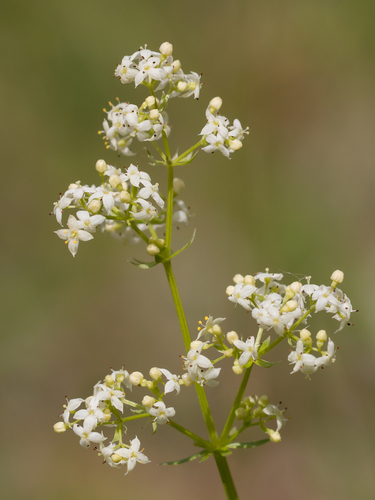
Hedge Bedstraw
Galium mollugo
Often called 'False Baby's Breath,' Hedge Bedstraw creates a magnificent cloud of white stars in summer meadows. This smooth-stemmed perennial is a favorite for pollinators and adds a delicate, wild aesthetic to any backyard corner.
Quick Identification
Size
Stems 30–120 cm (12–48 in) long; leaves 1.5–3 cm (0.6–1.2 in) long
Colors
Bright white flowers with four petals; deep green foliage; stems are light green and smooth
Key Features
- Whorls of 6-8 narrow, pointed leaves
- Smooth, square-shaped stems without hooks
- Cloud-like clusters of tiny white flowers
- Erect or scrambling growth habit reaching 4 feet
When You’ll See Them
Behavior
Hedge Bedstraw is a vigorous, scrambling perennial that acts as a structural 'weaver' in the garden. Unlike its cousin, the sticky Cleaver, Hedge Bedstraw has smooth stems that allow it to lean against neighboring plants or hedgerows for support without clinging aggressively. It spreads through a combination of creeping woody rhizomes and prolific seed production, often forming dense, frothy mats of white blooms that resemble decorative baby's breath.
Ecologically, this plant serves as an essential hub for biodiversity. Its dense growth provides excellent cover for ground-dwelling insects and small amphibians, while its nectar-rich flowers attract a wide array of specialist pollinators. In suburban settings, it is often found colonizing the edges of lawns or forgotten corners of flower beds, where it can quickly transform a bare patch into a lush, white-topped thicket during the height of summer.
EverydayEarth exclusive
Camera Tips
Capturing the beauty of Hedge Bedstraw with an AI camera requires a different approach than filming moving wildlife. To truly appreciate its growth, set your camera to 'Time-Lapse' mode. Position the camera on a short tripod or a ground stake about 12 to 18 inches from the base of a young cluster in late spring. By taking one frame every hour, you can create a stunning visual record of the plant 'scrambling' upward and the dramatic 'foaming' effect as the thousands of tiny buds burst into white flowers.
Lighting is your biggest challenge with such small, white flowers. Direct midday sun can 'blow out' the highlights, making the plant look like a white blur. To get the best detail in your photos, angle your camera to face North or South so the plant is side-lit during the morning and evening 'golden hours.' This will highlight the architectural whorls of the leaves and the delicate structure of the petals. If your camera allows for manual focus, lock it on the nearest flower cluster to prevent the AI from hunting for focus when the wind blows.
Hedge Bedstraw is a magnet for macro-wildlife. To capture the pollinators that visit, place the camera in 'Motion Trigger' mode but set the sensitivity to high. Since the flowers are small, many users have success using a clip-on macro lens over their trail camera's primary lens. This allows you to see the intricate details of hoverflies, solitary bees, and the elusive Hummingbird Hawk-moth, which is a frequent visitor to Bedstraw in many regions. Ensure the camera is angled slightly upward to capture the insects against the sky or a contrasting dark background.
Wind management is crucial for this species. Because the stems are tall and thin, they sway significantly in even a light breeze, which can lead to thousands of false triggers. To combat this, choose a patch that is sheltered by a fence or a denser hedge. You can also use a small garden stake to subtly secure the main stem you are focusing on, ensuring it stays within the camera's depth of field while the rest of the patch moves naturally in the background.
Finally, don't ignore the night-time activity. Many pale-colored wildflowers like Hedge Bedstraw are designed to be visible to nocturnal pollinators. Use a camera with a high-quality 'No-Glow' infrared flash to observe night-active moths visiting the blooms. To avoid overexposing the white flowers with IR light, place the camera at least 3-4 feet away and use the digital zoom to crop in, or place a piece of semi-transparent tape over a portion of the IR LED to soften the flash.
Similar Species
Species that look similar or are commonly confused with Hedge Bedstraw.
Frequently Asked Questions
Record Hedge Bedstraw at your habitat
Connect a camera to start building your own species record — AI identifies every visitor automatically.