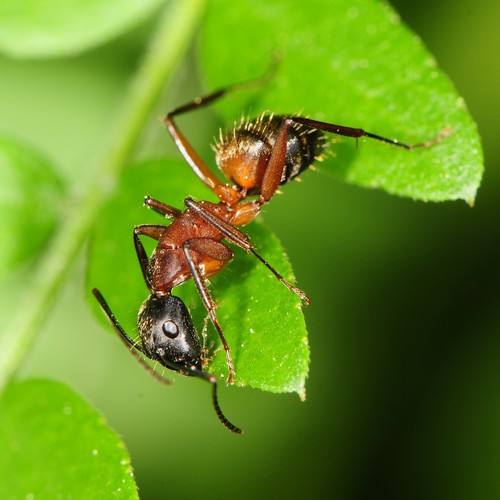
Ferruginous Carpenter Ant
Camponotus chromaiodes
Meet the architect of the undergrowth. The Ferruginous Carpenter Ant is a striking bi-colored marvel that plays a massive role in the health of our eastern forests.
Quick Identification
Size
Workers range from 6 to 13 mm (0.24 to 0.51 in); queens are significantly larger, reaching up to 20 mm (0.79 in).
Colors
Bi-colored with a distinctive rusty-red (ferruginous) thorax and legs, contrasting with a deep black head and abdomen.
Key Features
- Two-toned body with a reddish midsection and black head/rear
- Large, robust build typical of the Camponotus genus
- Fine, shimmering golden hairs on the abdomen
- Heart-shaped head with powerful mandibles
When You’ll See Them
Geographic range
Where Does the Ferruginous Carpenter Ant Live?
The Ferruginous Carpenter Ant is native to North America, with its primary range spanning the eastern United States and parts of the Midwest. It is commonly found from the Atlantic coast as far west as Nebraska and Kansas, thriving in temperate climates. While it is a staple of the eastern deciduous forests, there are also documented populations in parts of California, showing its resilience across varied American landscapes.
Basemap © OpenStreetMap contributors
Behavior
The Ferruginous Carpenter Ant is a social architect known for its impressive ability to carve out intricate galleries within wood. Unlike termites, these ants do not consume wood for nutrition; instead, they use their powerful mandibles to excavate nesting sites in stumps, logs, and sometimes the structural timbers of homes. They are highly organized, with a complex social structure consisting of a queen, drones, and polymorphic workers of various sizes that perform specialized tasks like foraging, nursery care, and colony defense.
These ants are primarily nocturnal or crepuscular, becoming most active as the sun sets. They are expert navigators, using chemical pheromone trails to guide colony members to food sources, which can be located hundreds of feet away from the main nest. While they can be territorial and will defend their nest if disturbed, they generally coexist peacefully with humans in backyard environments, serving as a vital part of the local ecosystem by aiding in the decomposition of old wood.
EverydayEarth exclusive
Camera Tips
To successfully capture Ferruginous Carpenter Ants on camera, you need to focus on their transit routes. Look for 'ant highways' on the trunks of large hardwood trees or along the top rails of wooden fences. Mounting your camera with a macro lens or at its closest possible focal distance is essential. Position the lens about 6 to 12 inches away from a known trail, ideally at an angle that catches the side profile of the ants to highlight their red-and-black coloration.
Baiting is the secret to getting high-quality, still images of these fast-moving insects. Place a small bottle cap filled with a mixture of sugar water and honey, or a small piece of ripe fruit, directly in the camera's field of view. This will cause the ants to stop and feed, giving your AI-powered camera plenty of time to trigger and focus on their intricate details. In suburban settings, placing the bait near an old stump or a woodpile is almost guaranteed to attract them.
Because this species is most active after dark, your camera's night vision capabilities are critical. Ensure your infrared flash is functioning well, but if the image appears washed out, try placing a small piece of semi-transparent tape over the flash to soften the light. This prevents the 'white-out' effect on their shiny black abdomens. Late spring and early summer are the best times for filming, especially during humid evenings when you might even catch the winged 'alates' or reproductive ants during their nuptial flights.
Similar Species
Species that look similar or are commonly confused with Ferruginous Carpenter Ant.
Frequently Asked Questions
Record Ferruginous Carpenter Ant at your habitat
Connect a camera to start building your own species record — AI identifies every visitor automatically.