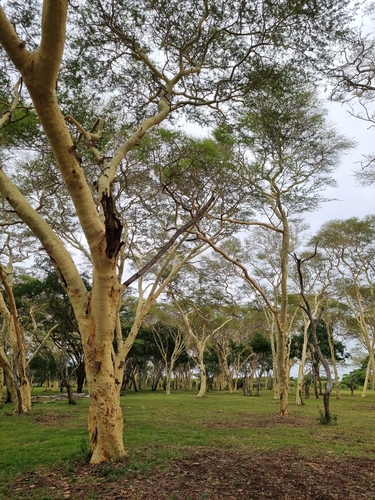
fever tree
Vachellia xanthophloea
With its ghostly lime-green bark and elegant thorny canopy, the fever tree is the iconic sentinel of the African wetlands. It is more than just a tree; it is a bustling ecosystem that supports everything from tiny sunbirds to wandering elephants.
Quick Identification
Size
Height: 15–25 m (50–80 ft); spread: 10–15 m (33–50 ft); trunk diameter up to 1.5 m (5 ft).
Colors
Luminous lime-green to greenish-yellow powdery bark; creamy white or pale yellow globose flowers; light brown seed pods.
Key Features
- Distinctive smooth, lime-green bark with a powdery finish
- Pairs of straight, white thorns up to 7 cm (3 in) long
- Feathery, bi-pinnately compound green leaves
- Spherical 'puffball' yellow flowers
When You’ll See Them
Geographic range
Where Does the fever tree Live?
Native to the eastern and southern regions of the African continent, the fever tree thrives in the warm, humid lowlands. Its core range extends from Kenya and Tanzania in East Africa through Malawi, Mozambique, and Zimbabwe, reaching its southern limit in the eastern parts of South Africa and Swaziland. While primarily a wild species of the African Rift Valley and coastal plains, it has been introduced as an ornamental landscape tree in other warm, frost-free climates worldwide.
Basemap © OpenStreetMap contributors
Behavior
The fever tree is a fast-growing, deciduous tree known for its striking architectural form and unique coloration. Its name originates from early European explorers who associated the tree with malaria, as it grows in the same swampy, low-lying areas where mosquitoes thrive. In reality, the tree is an essential part of the ecosystem, fixing nitrogen in the soil through its roots and providing a haven for a massive variety of birds and mammals.
Ecologically, the fever tree is highly social, often growing in dense, uniform stands known as 'forests' or 'groves' along riverbanks and lake margins. It serves as a high-traffic hub for wildlife; its leaves and pods provide nutritious fodder, while its thorny canopy offers protection for nesting birds. While it is generally a peaceful giant, it is hardy and can survive seasonal flooding that would drown other species.
EverydayEarth exclusive
Camera Tips
When using a trail camera to capture wildlife interaction with a fever tree, the tree itself acts as a massive natural 'lure.' Position your camera roughly 15 to 20 feet away from the main trunk, aiming slightly upward to capture the mid-canopy where giraffes and elephants often forage. Because of the tree's bright, reflective lime-green bark, you may need to adjust your exposure settings down by one stop to prevent 'blowout' in bright midday sun.
Fever trees are high-traffic zones for diverse species. To capture small birds or arboreal mammals like monkeys and bushbabies, mount a camera directly onto a sturdy branch roughly 2 to 3 metres high, facing a fork in the tree or a cluster of seed pods. If your camera has a time-lapse mode, use it to capture the incredible transition of the tree during its flowering phase when the canopy turns a brilliant misty yellow.
For those in suburban or garden settings where fever trees are planted, focus your camera on the base of the trunk during the night. The unique scent of the flowers often attracts nocturnal pollinators and browsers. If the tree is near a water source, keep your camera active at dawn and dusk, as the proximity to water and the shelter of the thorns make these trees a primary congregation point for thirsty wildlife.
Similar Species
Species that look similar or are commonly confused with fever tree.
Frequently Asked Questions
Record fever tree at your habitat
Connect a camera to start building your own species record — AI identifies every visitor automatically.