Paperbark Thorn
Vachellia sieberiana
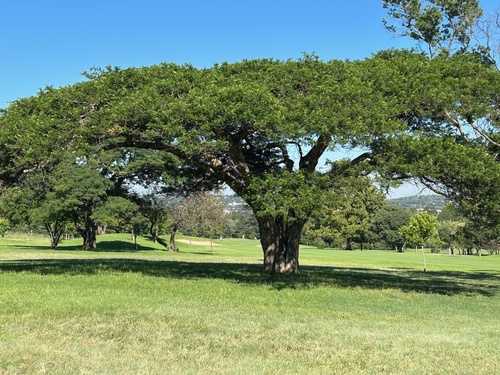
With its iconic flat-topped canopy and distinctive peeling bark, the Paperbark Thorn is the 'umbrella' of the African savanna, providing vital shade and sanctuary for a world of wildlife.
Quick Identification
Size
Height ranges from 3 to 25 m (10 to 82 ft) with a massive trunk diameter of 0.6 to 1.8 m (2 to 6 ft).
Colors
Pale yellowish to light brown papery bark; bright green bipinnate leaves; creamy-white to pale yellow globular flowers.
Key Features
- Distinctive yellowish corky bark that peels in papery strips
- Flat-topped, wide-spreading canopy resembling a classic African umbrella
- Paired, straight white thorns up to 10 cm in length
- Scented, ball-shaped creamy flower heads.
When You’ll See Them
Geographic range
Where Does the Paperbark Thorn Live?
The Paperbark Thorn is a quintessential feature of the landscape across Southern and East Africa. It is native to a broad swathe of territory including South Africa, Zimbabwe, Namibia, Botswana, and extending northwards into Kenya and Ethiopia. While its heartland is the African savanna, it has been successfully introduced to Pakistan, where it has naturalized in similar semi-arid environments.
Basemap © OpenStreetMap contributors
Behavior
The Paperbark Thorn is a cornerstone of the African savanna ecosystem, acting as a structural 'engineer' that provides essential microhabitats for a diverse range of wildlife. While it remains stationary, its life cycle is dynamic; it responds to seasonal rains with a sudden burst of fragrant, spherical blooms that attract a frantic array of pollinators, from honeybees to butterflies. The tree is a nitrogen-fixer, improving the soil quality around its base, which often leads to a 'resource island' effect where more lush grass grows beneath its canopy.
In human-dominated landscapes, this species is highly valued as a majestic shade tree for large gardens and parks. Its deep taproot system makes it exceptionally drought-resistant and stable, though it does drop large woody pods that are a favorite snack for local livestock and wild herbivores. Because it is relatively fast-growing for a hardwood, it is often used in suburban 'wildlife gardening' to attract birds that nest in its thorny branches for protection against predators.
EverydayEarth exclusive
Camera Tips
Capturing the life around a Paperbark Thorn requires a strategy focused on its role as a 'biological hub.' To see the widest variety of wildlife, aim your camera at a 45-degree downward angle toward the base of the trunk. This will capture the many herbivores, such as kudu or bushbuck, that visit to scavenge the nutritious fallen seed pods. For the best results, set your trigger speed to the fastest possible setting, as many visitors move quickly through the shade.
If you are interested in arboreal activity, secure your camera to a sturdy secondary branch approximately 2 to 3 meters off the ground, facing inward toward the main canopy. This is the ideal vantage point for spotting hole-nesting birds like barbets or wood-hoopoes, as well as tree-dwelling mammals like galagos (bushbabies) and vervet monkeys who use the thorny branches as a safe haven from ground predators.
Time-lapse mode is particularly rewarding with this species during the late spring. By setting your camera to take a photo every 30 minutes, you can document the spectacular 'greening up' of the canopy and the rapid transition from bud to flower. During the dry season, consider placing a small, shallow water basin near the base of the tree; the combination of the Paperbark's shade and available water will make your camera a magnet for every bird in the neighborhood.
Similar Species
Species that look similar or are commonly confused with Paperbark Thorn.
Sweet Thorn
Features dark bark and bright yellow flowers compared to the Paperbark's yellowish peeling bark and cream flowers.
Monkey Thorn
Has hooked 'cat-claw' thorns and much darker bark, lacking the papery texture of Vachellia sieberiana.
Fever Tree
Recognizable by its smooth, lime-green to yellow bark and a preference for much wetter, swampy ground.
Frequently Asked Questions
Record Paperbark Thorn at your habitat
Connect a camera to start building your own species record — AI identifies every visitor automatically.