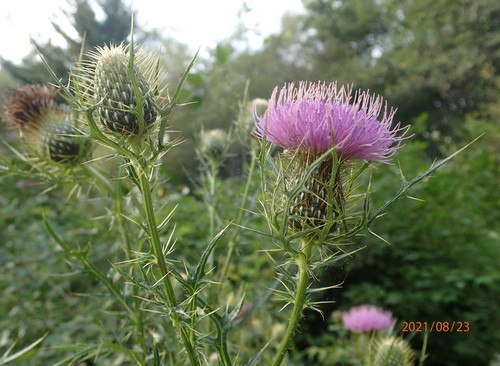
field thistle
Cirsium discolor
A towering icon of the American prairie, the Field Thistle is a silver-lined sanctuary for songbirds and butterflies. Its stunning two-toned leaves and nectar-rich blooms make it the ultimate centerpiece for any backyard wildlife station.
Quick Identification
Size
Height: 0.9–2.4 m (3–8 ft); Flower heads: 2.5–5 cm (1–2 in) wide
Colors
Soft lavender to pink-purple flower heads; bright green upper leaf surfaces with stark, woolly white undersides
Key Features
- Distinctive brilliant white felt-like undersides on leaves
- Tall, deeply lobed leaves with sharp spines
- Single, large flower heads on long stems
- Yellow-tipped spines on the green bracts below the flower
When You’ll See Them
Behavior
Unlike many of its aggressive, non-native cousins, the Field Thistle is a well-behaved native biennial or short-lived perennial. In its first year, it exists as a low-profile rosette of leaves, storing energy in a deep taproot. In its second year, it undergoes a dramatic transformation, sending up a towering, branched stalk that can reach heights of eight feet, topped with crowning purple blooms.
This plant acts as a vital community hub for local wildlife. It doesn't move in the traditional sense, but it tracks the sun and responds to the seasons with a spectacular display of nectar production and seed dispersal. It is a social plant in the ecological sense, often surrounded by a buzzing halo of pollinators by day and serving as a sturdy perch for birds by evening.
EverydayEarth exclusive
Camera Tips
Capturing the Field Thistle is less about the plant itself and more about documenting the incredible 'wildlife airport' it creates. To get the best results, position your camera at a mid-to-high angle, roughly 4 to 5 feet off the ground, aiming slightly downward at the flower heads. This placement allows you to capture the top-down beauty of visiting Monarch butterflies and the side profiles of Goldfinches as they land to feast on the seeds.
Because this species is known for the striking contrast between its green leaf tops and white undersides, try to set up your camera so the morning or evening sun hits the foliage from the side. This 'rim lighting' will make the white 'discolor' (two-toned) feature pop on your video feed. If your camera has a macro or close-focus mode, use it; the intricate geometry of the thistle’s bracts and the individual florets make for stunning high-definition captures.
Don't just set your camera for motion triggers during the day. As the flower heads turn to fluffy white seed heads (pappus) in late summer, birds like the American Goldfinch will visit frequently. Use a 'time-lapse' setting during the late afternoon to see the transition of these birds systematically deconstructing the seed heads. Also, ensure your camera's sensitivity is high enough to pick up the fluttering of butterfly wings, as the Field Thistle is one of the top nectar sources for migrating Monarchs.
Lastly, consider the wind. Tall thistles sway significantly, which can cause 'false triggers' on some AI cameras. To prevent a gallery full of empty swaying stems, use a garden stake to subtly secure the main stalk of the thistle outside of the camera's field of view. This stabilizes the flower head, ensuring that when the AI triggers, it's because a visitor has landed, providing you with a much clearer, sharper image of the bird or insect.
Similar Species
Species that look similar or are commonly confused with field thistle.
Bull Thistle
Bull Thistle has leaves that are green on both sides and stems that are 'winged' with prickly tissue, whereas Field Thistle leaves are white underneath.
Tall Thistle
Very similar, but Tall Thistle (Cirsium altissimum) usually has mostly unlobed leaves, whereas Field Thistle leaves are deeply divided/lobed.
Frequently Asked Questions
Record field thistle at your habitat
Connect a camera to start building your own species record — AI identifies every visitor automatically.