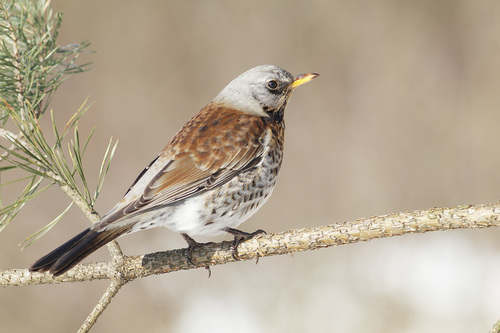
Fieldfare
Turdus pilaris
A social and striking winter visitor, the Fieldfare is a grey-headed thrush that brings a touch of wild Scandinavia to backyards across Europe and Asia. Watch for their nomadic flocks and bold, spotted chests during the year's coldest months.
Quick Identification
Size
Length 22–28 cm (8.7–11 in), wingspan 39–42 cm (15–17 in), weight 80–140 g (2.8–4.9 oz)
Colors
Blue-grey head, nape, and rump; rich chestnut brown back; blackish tail; creamy-buff breast with bold black arrow-shaped spotting; white underwings.
Key Features
- Distinctive blue-grey head and rump contrasting with a chestnut back
- Heavy black spotting on a warm buff breast and flanks
- White underwing coverts clearly visible during its undulating flight
- Large, social thrush often seen in noisy flocks
When You’ll See Them
Geographic range
Where Does the Fieldfare Live?
Native to the Palearctic, the Fieldfare is a hardy traveler that breeds across the boreal forests and scrublands of Northern Europe, Scandinavia, and Russia, extending deep into Siberia. As winter approaches, these northern populations undertake massive migrations, flooding into the United Kingdom, Southern Europe, North Africa, and parts of the Middle East. They are highly nomadic during the winter months, moving frequently across these regions to follow the best available berry crops.
Basemap © OpenStreetMap contributors
Behavior
Fieldfares are highly social and gregarious birds, particularly outside of the breeding season. Unlike many other thrushes that prefer solitude, Fieldfares are almost always found in large, nomadic flocks that can number in the hundreds. They are famous for their 'tsak-tsak-tsak' chattering call, which often announces their arrival in a neighborhood long before they are seen. During the winter, they move across the landscape in search of food, often defended by the group against other birds.
When foraging, they exhibit a classic thrush-like 'run and pause' movement on the ground. In the breeding season, they are known for their colonial nesting habits and aggressive defense of their territory; they have a unique defense mechanism where they 'dive-bomb' predators, including crows and hawks, while defecating on them to gum up their feathers. In backyard settings, they are initially shy but can become quite bold if a reliable source of fruit is provided during freezing weather.
EverydayEarth exclusive
Camera Tips
To capture the best footage of Fieldfares, position your AI-powered camera near ground level or on a low stump, as these birds spend a significant amount of time foraging on the floor. During the winter, the most effective 'bait' is fallen fruit. Scatter halved apples or pears in a clear, open area of your garden; Fieldfares are particularly fond of slightly fermenting fruit. Aim the camera at a 10-15 degree downward angle to capture the intricate patterns on their breast and their distinctive grey rumps as they hop between treats.
Because Fieldfares are social, try to use a wider-angle lens setting if your camera allows it. This will help you capture the group dynamics and the 'scuffles' that often break out when multiple birds try to claim the same apple. If you have a berry-bearing bush like Holly, Rowan, or Pyracantha, mounting a camera on a nearby fence post facing the berries is a sure-fire way to get high-action feeding shots during a frost.
Regarding technical settings, Fieldfares are very active birds, so use a fast shutter speed or a high frame rate (60fps) to avoid motion blur during their quick 'run and pause' movements. Since they are most active during the low light of winter mornings, ensure your camera has good low-light sensitivity. Battery life can drop in the cold months when Fieldfares are most common, so consider a solar panel attachment or external battery pack to ensure you don't miss the flock's arrival.
Similar Species
Species that look similar or are commonly confused with Fieldfare.
Mistle Thrush
Larger and paler with rounder spots; lacks the Fieldfare's contrasting blue-grey head and rump.
Redwing
Smaller with a bold white stripe over the eye (supercilium) and orange-red patches under the wings.
Song Thrush
Much smaller and warmer brown overall; lacks any grey on the head and has a more melodic, repetitive song.
Frequently Asked Questions
Record Fieldfare at your habitat
Connect a camera to start building your own species record — AI identifies every visitor automatically.