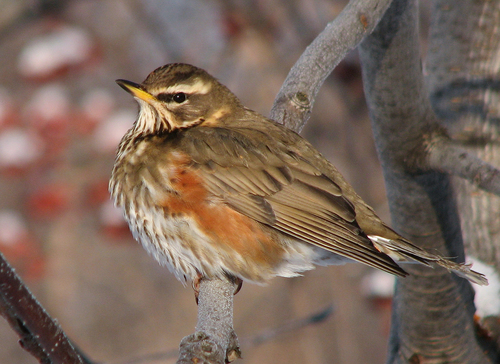
Redwing
Turdus iliacus
A hardy winter visitor from the north, the Redwing is easily identified by its striking white 'eyebrow' and the flash of rusty-red along its sides. These social thrushes are a seasonal favorite for backyard observers, arriving in chattering flocks to feast on winter berries.
Quick Identification
Size
Length: 20–24 cm (7.9–9.4 in); Wingspan: 33–35 cm (13–14 in); Weight: 50–75 g (1.8–2.6 oz)
Colors
Olive-brown back, creamy-white underparts with dark streaking, distinct white 'eyebrow' stripe, and rusty-red patches on the flanks and underwings. Males and females are identical.
Key Features
- Prominent creamy-white supercilium (eyebrow) stripe
- Bold orange-red patches on the flanks and underwings
- Densely streaked white breast and belly
- Smallest of the common European thrushes
When You’ll See Them
Behavior
EverydayEarth exclusive
Camera Tips
To capture the Redwing on camera, your best bet is a ground-level setup during the winter months. Because they are shy, position your AI-powered camera near a natural 'magnet' such as a berry-bearing shrub like Holly or Pyracantha. Set the camera on a small tripod or mount it to a fence post approximately 12–18 inches (30–45 cm) off the ground. Angling the camera slightly upward is a great trick for this species; it helps the AI identify the diagnostic red flank patches that are often hidden by the wings when the bird is viewed from above.
Luring Redwings is most effective during cold snaps. Scatter halved apples, soaked raisins, or mealworms directly on the ground in a clear patch of lawn near cover. Since Redwings are often part of a larger flock, using a wide-angle setting or a 'Group' trigger mode will help you capture the social dynamics. If your camera has a high-speed shutter or 'Pro' mode, use it—Redwings are twitchy feeders and can easily blur in low winter light. Aim for a shutter speed of at least 1/500s if possible.
Timing is everything with these migratory thrushes. They are most active in the early morning as they refuel after cold nights. Ensure your camera is positioned so the low winter sun is behind the lens to prevent 'white-out' on their pale breasts. Because Redwings are extremely sensitive to movement, look for a camera with a silent trigger or a remote placement option so they don't associate your house with the equipment. In regions where they don't breed, your window of opportunity is strictly late autumn through early spring, so keep your batteries charged and your memory cards clear starting in October.
Similar Species
Species that look similar or are commonly confused with Redwing.
Frequently Asked Questions
Record Redwing at your habitat
Connect a camera to start building your own species record — AI identifies every visitor automatically.