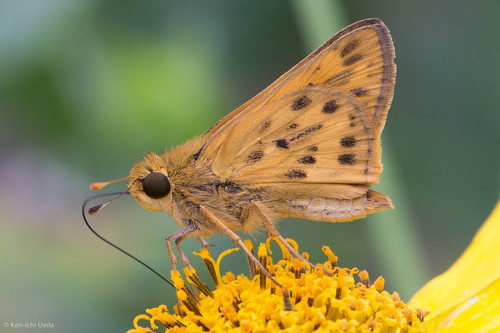
Fiery Skipper
Hylephila phyleus
A flash of golden-orange in the summer sun, the Fiery Skipper is the high-energy athlete of your backyard garden. These tiny powerhouses are famous for their rapid, darting flight and their unique ability to thrive in our suburban lawns.
Quick Identification
Size
Wingspan of 1 to 1.5 inches (2.5 to 3.8 cm); body length approximately 1 inch (2.5 cm)
Colors
Males are vibrant orange or golden-yellow with jagged blackish-brown borders; females are a more muted dark brown with irregular orange-tan spots.
Key Features
- Triangular wing shape with a rapid, 'skipping' flight pattern
- Short antennae with distinct hooked ends called apiculi
- Jagged, saw-tooth dark margin on the trailing edge of male wings
- Distinctive 'jet-plane' resting posture with forewings held upright and hindwings flat
When You’ll See Them
Behavior
Fiery Skippers are the high-octane athletes of the butterfly world. Unlike the slow, fluttering flight of a Monarch, these small insects move with incredible speed and precision, 'skipping' from flower to flower so quickly they can be difficult to follow with the naked eye. They are sun-loving creatures that are most active during the hottest parts of the day, often seen basking on leaves or zip-lining across a lawn.
Males are notably territorial. You will often see them perched on a low-lying leaf or a blade of grass, aggressively defending their small patch of sunlight. If another male enters their airspace, they engage in a high-speed spiral chase until the intruder is driven away. This 'perch and wait' strategy is also how they locate females for mating.
Because their larvae feed on common lawn grasses, Fiery Skippers have adapted remarkably well to suburban life. They are one of the few butterfly species that can be more common in a well-watered backyard than in a pristine wilderness area, making them a perfect subject for backyard wildlife enthusiasts.
EverydayEarth exclusive
Camera Tips
Capturing a Fiery Skipper on camera requires a focus on 'landing pads.' Because these butterflies are so fast, trying to catch them mid-flight is nearly impossible for standard backyard AI cameras. Instead, mount your camera 12 to 18 inches away from nectar-rich flowers like Lantana or Zinnias. Position the camera at the same height as the flower heads to capture the intricate details of their hooked antennae and the jagged wing margins.
Lighting is your best friend when filming these golden insects. Place your camera with the sun behind it (facing north or south) to avoid silhouettes. The vibrant oranges and yellows of the male Fiery Skipper really 'pop' under direct midday sun. If your camera allows for manual shutter speed adjustments, high-speed settings are essential to freeze their rapid wing movements, which often pulse even while the insect is feeding.
Since these skippers are small, use a macro lens or a camera with a short minimum focal distance. If you are using an AI-powered trail camera, set the trigger sensitivity to 'High.' Their small body mass might not trigger sensors calibrated for mammals, so you want the most sensitive setting possible to ensure the camera wakes up the moment they land on a bloom.
Don't forget the ground! Because the males perch on grass to defend territories, setting up a camera on a low tripod or 'ground spike' aimed at a sunny patch of lawn can yield fantastic footage of their territorial displays. Look for a spot where the grass meets a flower bed; this 'edge' habitat is a favorite patrol zone for males looking for both food and rivals.
Similar Species
Species that look similar or are commonly confused with Fiery Skipper.
Frequently Asked Questions
Record Fiery Skipper at your habitat
Connect a camera to start building your own species record — AI identifies every visitor automatically.