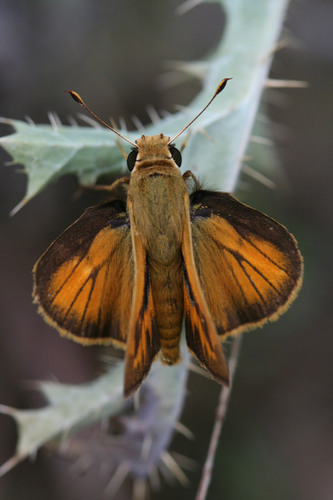
Whirlabout
Hedone vibex
A golden-hued speedster of the garden, the Whirlabout is famous for its rapid-fire flight and intricate wing patterns. Often found darting across suburban lawns, this hardy skipper is a delight for backyard observers to track.
Quick Identification
Size
Wingspan of 1 to 1.25 inches (2.5 to 3.2 cm); total body length approx. 0.5 inches (1.3 cm).
Colors
Males are bright yellow-orange with a prominent, thick black 'stigma' (scent patch) on the forewing. Females are much darker, ranging from brownish-gray to olive, with pale yellow spots arranged in a 'whirled' pattern on the hindwing.
Key Features
- Distinctive hooked antennae (apiculi) common to skippers
- Male has a thick, jagged black dash on the upper forewing
- Female hindwings show a characteristic circular arrangement of pale spots
- Small, stocky body with large, dark eyes
When You’ll See Them
Behavior
The Whirlabout is a high-energy member of the skipper family, known for its incredibly fast and erratic flight. Unlike the slow, fluttering flight of a Monarch or Swallowtail, the Whirlabout 'zips' from flower to flower so quickly it can be hard for the human eye to track. They are highly territorial; males often pick a sunny 'perch' on a blade of grass or a low leaf, darting out to investigate anything that flies by, whether it's a potential mate or a rival male.
These butterflies are sun-lovers and spend the hottest parts of the day actively foraging for nectar. When they land, they often hold their wings in a 'jet plane' position—the hindwings are spread flat while the forewings are held at a 45-degree angle. This is a classic skipper pose that helps them absorb heat while remaining ready for a quick takeoff. While they are solitary, you may find several of them congregating in a particularly rich patch of nectar plants like Lantana or Zinnia.
EverydayEarth exclusive
Camera Tips
Capturing a Whirlabout on camera requires a strategy focused on 'stationary targets' because their flight is too fast for most motion sensors. The best approach is to aim your camera at a cluster of nectar-rich flowers like Lantana, Zinnia, or Porterweed. Position your camera on a tripod or mount at a height of 12 to 24 inches above the ground, which is the 'sweet spot' for skipper activity. Use a macro lens or a camera with a close-focusing distance to capture the fine details of the wing markings.
Because these insects are small, a standard wide-angle trail camera might miss them or produce a blurry image. For the best results, use a camera that offers a 'Burst Mode' or high-speed video. Set the trigger sensitivity to high, but be aware that wind-blown flowers might cause false triggers. To prevent this, try to shield the target flower patch from heavy wind or use a manual trigger if you are observing from a distance. Lighting is your friend here—ensure the flower patch is in full, direct sun, as Whirlabouts rarely visit shaded areas.
Another pro tip for 'luring' them into frame is to create a 'puddling station.' Whirlabouts, especially males, often land on damp soil to drink minerals. Placing a shallow dish of wet sand or even a slightly muddy patch of ground in front of your camera can result in much longer 'dwell times' than flowers, giving your AI camera plenty of time to identify the species. If using a trail camera, set the video length to at least 10-15 seconds to catch their characteristic wing-flicking behavior.
Similar Species
Species that look similar or are commonly confused with Whirlabout.
Frequently Asked Questions
Record Whirlabout at your habitat
Connect a camera to start building your own species record — AI identifies every visitor automatically.