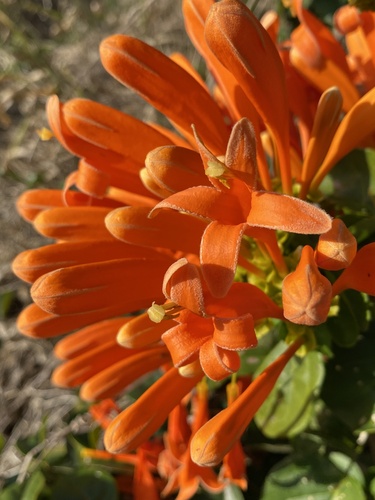
Flame vine
Pyrostegia venusta
A cascading waterfall of brilliant orange, the Flame vine is a winter-blooming powerhouse that transforms fences into living tapestries. Its nectar-rich tubes are a lifeline for hummingbirds and a vibrant focal point for any backyard wildlife camera.
Quick Identification
Size
Vines can reach lengths of 20 to 30 feet (6–9 meters); flower clusters are 2–3 inches (5–7 cm) long.
Colors
Brilliant reddish-orange to bright orange tubular flowers; glossy dark green foliage.
Key Features
- Cascading clusters of tubular orange flowers
- Glossy evergreen leaves with 2-3 leaflets
- Modified three-forked tendrils for climbing
- Blooms primarily during winter and early spring
When You’ll See Them
Behavior
The Flame vine is a vigorous, fast-growing evergreen climber known for its spectacular winter display. It uses its specialized three-forked tendrils to cling to almost any surface, allowing it to quickly drape over fences, pergolas, and even large trees. While it is a plant, its "behavior" in the garden is one of rapid expansion, often creating dense mats of foliage that provide excellent nesting cover for small birds.
This species is a vital ecological resource because it typically blooms from late autumn through winter when most other nectar sources are dormant. In the backyard setting, it acts as a central hub for pollinators. It is particularly well-adapted to attract long-billed birds, which are essential for its pollination, creating a high-traffic area for anyone interested in backyard wildlife observation.
EverydayEarth exclusive
Camera Tips
To capture the best footage of the Flame vine and its visitors, position your camera at a slight upward angle toward a dense cluster of blooms. Since this plant is a primary magnet for hummingbirds and butterflies, setting your AI-powered camera to 'Burst Mode' or high-speed video is essential. Aim for a focal point about 2 to 4 feet away from a prominent hanging cluster where you notice the most floral openings. Early morning light, specifically between 8:00 AM and 10:00 AM, provides a soft glow that accentuates the orange petals without the harsh, washing effect of the midday sun.
Because Flame vine is often used as a privacy screen on chain-link or wooden fences, it provides a perfect vertical stage for wildlife photography. Place your camera at chest height, mounted parallel to the vine's surface. This orientation allows you to catch hummingbirds in profile as they hover to insert their bills into the tubular flowers. If your camera uses PIR (Passive Infrared) sensors, increase the sensitivity to its highest setting; hummingbirds move with incredible speed and can sometimes pass through a frame before a low-sensitivity sensor triggers the recording.
In the peak of winter when the vine is in full flush, consider using a time-lapse setting to document the opening of the flower clusters. This creates a stunning visual narrative of the plant's life cycle. For nighttime visitors like sphinx moths, ensure your camera is equipped with 'no-glow' infrared LEDs. Standard red-glow LEDs can sometimes startle nectar-feeding insects, and the 'no-glow' variety ensures you capture natural behavior without overexposing the bright, reflective surfaces of the waxy orange flowers.
Similar Species
Species that look similar or are commonly confused with Flame vine.
Frequently Asked Questions
Record Flame vine at your habitat
Connect a camera to start building your own species record — AI identifies every visitor automatically.