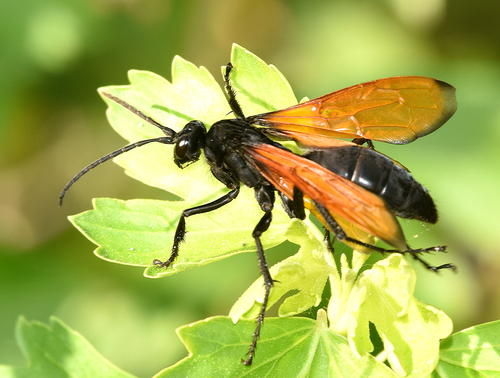
Flamed Tarantula-hawk Wasp
Hemipepsis ustulata
A flash of brilliant orange against a desert-blue sky, the Flamed Tarantula-hawk Wasp is the Southwestern scrub's most impressive aerial hunter. These giants of the wasp world bring a touch of prehistoric drama to any backyard garden.
Quick Identification
Size
Body length 20–50 mm (0.8–2.0 in); wingspan up to 100 mm (4 in)
Colors
Deep metallic blue-black body with vibrant, fiery orange-red wings and dark tips
Key Features
- Striking metallic blue-black iridescent body
- Bright orange-red wings with dark trailing edges
- Extraordinarily long, hooked legs
- Large, robust build reaching up to 2 inches
- Slow, deliberate flight pattern with loud humming
When You’ll See Them
Behavior
The Flamed Tarantula-hawk Wasp is one of the most striking and formidable insects you’ll encounter in the Southwest. Despite their intimidating size and reputation, adults are surprisingly peaceful nectar-feeders, often found delicately hovering over flowering plants during the heat of the day. They are solitary creatures, meaning they don't live in colonies or defend hives; each female works alone to provide for her future offspring.
The drama of their life cycle is legendary. Female wasps hunt tarantulas, engaging in a high-stakes wrestling match to deliver a paralyzing sting. Once the spider is immobilized, the wasp drags it into a burrow, lays a single egg on it, and seals the tomb. This provides the emerging larva with a fresh, living food source. Males, meanwhile, spend their time 'lekking'—claiming high ground on hilltops or tall bushes and defending these territories against rivals to attract passing females.
While they possess one of the most painful stings in the insect kingdom, they are not aggressive toward humans. They are generally indifferent to your presence unless you attempt to handle them or accidentally step on one. In a backyard setting, they are fascinating to observe from a distance as they contribute to the natural balance of the local ecosystem.
EverydayEarth exclusive
Camera Tips
To capture high-quality footage of a Flamed Tarantula-hawk Wasp, focus your camera on high-nectar 'pollinator magnet' plants. Milkweed (Asclepias), Western Soapberry trees, and Mesquite are their favorite dining spots. Set your camera on a tripod at roughly the same height as the blooms, usually 3 to 5 feet off the ground, and use a macro lens if possible to capture the metallic sheen of their armor. Because they move with quick, jerky motions while feeding, a high frame rate (60fps or higher) is essential for smooth playback.
If you live near a hill or have a particularly tall shrub in an open area, look for 'hilltopping' behavior. Males often return to the exact same high branch day after day to survey their territory. If you spot one landing repeatedly on a specific twig, mount your camera nearby with a narrow field of view. This is your best chance to get clear, still shots of the wasp while it is at rest and scanning for mates.
Lighting is your best friend when filming these insects. Their iridescent blue bodies only truly 'pop' under direct, bright sunlight. Position your camera so the sun is behind you, illuminating the wasp's wings and body. Avoid using motion-trigger settings unless your camera has a very fast 'wake-up' time; instead, use time-lapse mode or continuous recording during the peak heat of the afternoon when they are most active. A shallow depth of field will help blur out busy garden backgrounds, making the fiery orange wings the star of the shot.
Similar Species
Species that look similar or are commonly confused with Flamed Tarantula-hawk Wasp.
Frequently Asked Questions
Record Flamed Tarantula-hawk Wasp at your habitat
Connect a camera to start building your own species record — AI identifies every visitor automatically.