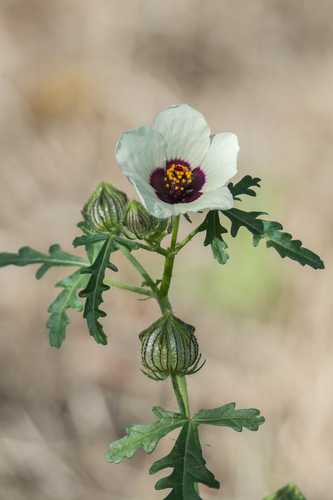
flower-of-an-hour
Hibiscus trionum
A fleeting beauty of the summer garden, the flower-of-an-hour reveals its stunning dark-eyed blooms for only a few hours each morning. This resilient annual is a master of timing, synchronizing its display with the peak of the midday sun.
Quick Identification
Size
Grows 6 to 20 inches (15–50 cm) tall with a sprawling spread of up to 24 inches (60 cm).
Colors
Creamy pale-yellow or white petals with a distinct dark burgundy or purple-black center; green stems often covered in fine bristles.
Key Features
- Pale yellow petals with a deep purple 'eye' at the center
- Papery, inflated calyx (seed pod) with dark longitudinal veins
- Deeply lobed foliage divided into three distinct segments
- Flowers open only in bright sunlight and for a few hours at a time
When You’ll See Them
Behavior
The flower-of-an-hour is a fascinating annual that lives up to its name through its incredibly brief blooming window. On sunny days, the delicate flowers unfurl to reveal a striking dark center, but they rarely stay open for more than a few hours, usually closing by midday. This strategy is an adaptation to preserve moisture and energy, focusing their reproductive efforts during the peak activity of their favorite pollinators.
As an annual, this plant puts all its energy into rapid growth and seed production. Once the flower closes and wilts, the calyx—the green base of the flower—begins to inflate like a small, translucent balloon. These 'bladders' protect the developing seeds until they are ready to be dispersed. While often considered a weed in agricultural settings, it is a charming addition to pollinator gardens where its rapid lifecycle provides a quick burst of late-summer interest.
EverydayEarth exclusive
Camera Tips
Capturing the flower-of-an-hour on a trail camera requires a different strategy than tracking moving wildlife. To truly appreciate this species, utilize your camera’s time-lapse mode rather than the motion trigger. Set your interval to capture one photo every 5 to 10 minutes starting around 8:00 AM. This will allow you to create a stunning video sequence of the flower unfurling as the sun hits it and closing up as the day warms, a process that is often too slow to notice with the naked eye.
Placement is critical because these plants are low-growers. Mount your camera on a short stake or use a ground-level 'tortoise' mount about 12 to 18 inches from the plant. Ensure you clear away any tall grasses or competing weeds that might blow in the wind and trigger the sensor unnecessarily, or worse, obscure the delicate bloom. If your camera allows for macro focus or has a close-up lens attachment, use it; the fine hairs on the stems and the intricate purple veins on the 'bladder' pods are beautiful details that are easily missed from a distance.
Lighting is your best friend with this species. Position your camera facing south or southeast so the morning sun illuminates the face of the flower. Since Hibiscus trionum only opens in high light, the best shots will happen during the brightest part of the morning. If you are using an AI-powered camera like those featured on EverydayEarth, look for tags related to 'pollinators.' Even if the camera doesn't identify the plant itself, it will often trigger when bees or small butterflies visit the dark nectar guides at the center of the bloom.
Finally, don't stop recording once the petals drop. The subsequent development of the inflated seed pods is equally interesting. Over the course of a week, you can document the 'bladder' swelling and turning from green to a translucent tan. This provides a great educational look at the plant's reproductive cycle. For the best color accuracy, ensure your white balance is set to 'Auto' or 'Daylight' to capture the specific pale-sulfur yellow of the petals.
Similar Species
Species that look similar or are commonly confused with flower-of-an-hour.
Frequently Asked Questions
Record flower-of-an-hour at your habitat
Connect a camera to start building your own species record — AI identifies every visitor automatically.