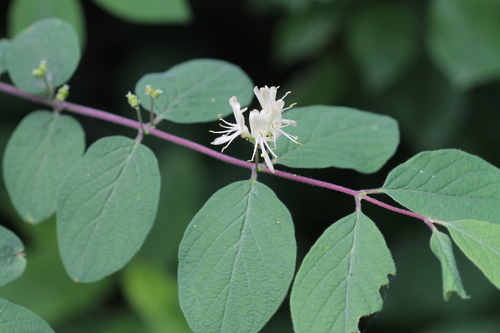
Fly Honeysuckle
Lonicera xylosteum
A resilient and bushy woodland staple, the Fly Honeysuckle is famous for its paired 'twin' flowers and brilliant red summer berries. It provides essential cover and a bustling hub of activity for backyard birds and pollinators.
Quick Identification
Size
2-3 meters (6.5-10 ft) in height with a similar spread
Colors
Gray-brown shaggy bark, dull green leaves with grayish undersides, and yellowish-white flowers that transition to deep red berries.
Key Features
- Opposite, oval-shaped leaves with soft hairy undersides
- Pairs of creamy white to pale yellow tubular flowers
- Glossy red berries that grow in distinct pairs, often fused at the base
- Older stems have a hollow brown pith when cut
When You’ll See Them
Behavior
Fly Honeysuckle is a hardy, deciduous shrub known for its early leaf-out in the spring and its structural contribution to the woodland understory. Unlike its vine-like relatives, this species grows as an upright, multi-stemmed bush. It plays a significant role in its local ecosystem by providing one of the first sources of dense cover for ground-foraging birds and small mammals as winter recedes.
As the season progresses, the shrub undergoes a distinct transformation from its subtle, twin-flowered spring bloom to its vibrant, berry-laden summer appearance. While it is a vigorous grower that can tolerate a variety of soil conditions, it is often found in disturbed areas or along the edges of suburban properties. In some regions of North America, it is managed as an invasive species because its dense growth can shade out native wildflowers and seedlings.
EverydayEarth exclusive
Camera Tips
When targeting Fly Honeysuckle with your backyard camera, remember that you are capturing a stationary subject that acts as a magnet for other wildlife. To document the shrub's own growth cycle, mount your camera on a steady post or a nearby tree at a height of 3 to 5 feet. Using a time-lapse setting—capturing one frame every 1 to 2 hours during daylight—is the most effective way to see the rapid transition from the pale 'twin' flowers of May to the bright red berries of July.
To capture the animals that visit the Fly Honeysuckle, position your camera about 4 to 6 feet away from a cluster of berries or flowers. Because this shrub is very twiggy, the biggest challenge is avoiding 'false triggers' caused by wind. Trim away any small, thin branches that sit directly in front of the lens sensor. Set your camera’s PIR (Passive Infrared) sensitivity to 'Medium' to ensure it picks up small songbirds like catbirds or waxwings that come to investigate the fruit, without being triggered by every breeze.
Seasonal timing is critical for the best footage. In late spring, aim your camera at the flowers during the early morning or dusk to catch clearwing moths and bees. In late summer, refocus on the ripening berries to catch fruit-eating birds. If you are using a camera with high-definition video capability, ensure your trigger speed is set to its fastest setting (0.3 seconds or less), as birds move quickly through the dense branches of the honeysuckle. For nighttime monitoring, the base of the Fly Honeysuckle is a great spot to catch foraging rabbits or opossums seeking fallen fruit or insects attracted to the leaf litter.
Similar Species
Species that look similar or are commonly confused with Fly Honeysuckle.
Morrow's Honeysuckle
Morrow's has much hairier leaves and its white flowers turn a distinct yellow as they age, whereas Fly Honeysuckle flowers remain pale white or greenish-yellow.
American Fly Honeysuckle
A native relative that features solid white pith in its stems and more elongated, pointed leaves compared to the rounded leaves of the European Fly Honeysuckle.
Frequently Asked Questions
Record Fly Honeysuckle at your habitat
Connect a camera to start building your own species record — AI identifies every visitor automatically.