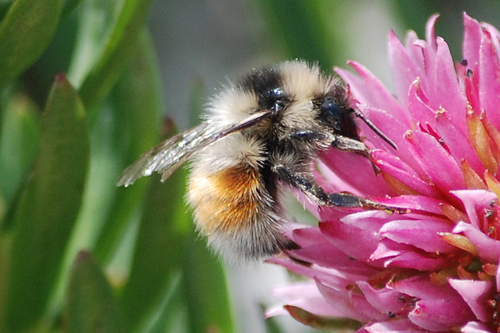
Forest Bumble Bee
Bombus sylvicola
The Forest Bumble Bee is a vibrant, cold-weather specialist that brings life to northern forests and mountain meadows. With its striking orange bands and fuzzy coat, it is one of the most charismatic pollinators you can spot in a high-altitude backyard.
Quick Identification
Size
Workers: 9–11 mm (0.35–0.43 in); Queens: 15–18 mm (0.59–0.71 in); Wingspan: 20–30 mm
Colors
Distinctive orange or reddish bands on the middle of the abdomen, bordered by yellow and black; yellow and black thorax
Key Features
- Bright orange/red bands on the 2nd and 3rd abdominal segments
- Dense, shaggy hair adapted for cold climates
- Yellow hair on the face and vertex
- Small to medium-sized stocky build
When You’ll See Them
Behavior
The Forest Bumble Bee is a hardy high-altitude specialist, renowned for its ability to fly in temperatures that would freeze most other insects. As a social species, they live in annual colonies that begin with a single overwintering queen. In the spring, she emerges from the soil or leaf litter to find a suitable nesting site—often a discarded mouse burrow or a hollow beneath a pile of forest debris—where she begins the arduous task of raising her first generation of workers alone.
Once the colony is established, these bees exhibit complex social structures, with workers taking over foraging duties while the queen focuses on egg-laying. They are known for 'buzz pollination,' a technique where they vibrate their flight muscles at a specific frequency to dislodge pollen from stubborn flowers. Despite their industrious nature, they are gentle creatures and will typically only sting if their nest is directly threatened, making them safe and fascinating neighbors for backyard observers.
EverydayEarth exclusive
Camera Tips
Capturing the Forest Bumble Bee on camera requires a specialized approach due to their small size and rapid movement. Standard trail cameras often have a minimum focal distance of several feet, which will result in a blurry bee. To capture clear, high-definition shots, use a camera with a macro lens or a dedicated 'close-up' setting. Position your camera approximately 6 to 12 inches away from a cluster of nectar-rich flowers. Native perennials like Penstemon or Bee Balm are perfect 'stages' for these bees, as they spend several seconds at each bloom, giving the camera's sensor time to trigger and focus.
Lighting is the most critical factor for insect photography. Set your camera in an area that receives bright, indirect morning sun. Direct, harsh midday sun can wash out the vibrant orange and yellow colors of the bee's fur, while deep shade will likely lead to motion blur. A frame rate of at least 60fps is recommended if you are shooting video; this allows you to slow down the footage to see the incredible mechanics of their wing beats and how they use their legs to pack pollen into their 'pollen baskets' (corbiculae).
Since bumble bees are not easily picked up by standard PIR heat-motion sensors, it is often more effective to use a 'time-lapse' mode or a 'motion zone' trigger if your AI camera supports it. Set the interval to capture a photo every 5 seconds during peak activity hours. If you are using an AI-powered system, ensure the detection zone is focused tightly on the flower petals. Avoid using artificial lures or sugar water; instead, provide a diverse array of native blooming plants to encourage natural foraging behavior that results in much more authentic and educational footage.
For the best seasonal results, start your monitoring as soon as the first spring wildflowers appear. In high-elevation areas, this might not be until June. Early in the season, you have the best chance of filming the large, impressive queens as they scout for nests. By mid-summer, the smaller, more numerous workers will be the stars of your footage. Keep your camera low to the ground, angled slightly upward to catch the underside of the bee, which often reveals the intricate details of their legs and the fuzziness that helps them carry pollen.
Similar Species
Species that look similar or are commonly confused with Forest Bumble Bee.
Black-tailed Bumble Bee
The Black-tailed Bumble Bee has similar orange bands but usually lacks the dense yellow facial hair of the Forest Bumble Bee and has a smoother hair texture.
Hunt's Bumble Bee
Hunt's Bumble Bee has a much brighter, more saturated yellow thorax and its hair is shorter and more even, giving it a 'neater' appearance.
Frequently Asked Questions
Record Forest Bumble Bee at your habitat
Connect a camera to start building your own species record — AI identifies every visitor automatically.