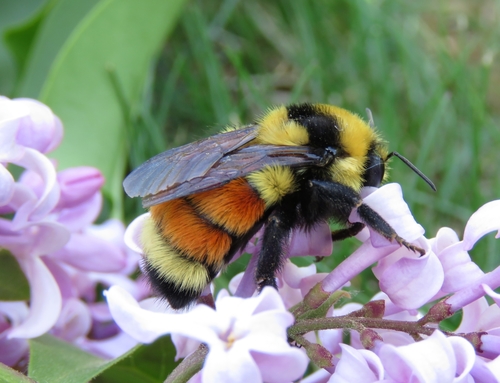
Hunt's Bumble Bee
Bombus huntii
Meet the 'sunset' of the bee world. With its fiery orange-red bands and tireless work ethic, Hunt's Bumble Bee is a jewel of the Western American backyard.
Quick Identification
Size
Queens: 18-20mm (0.7-0.8 in); Workers: 10-15mm (0.4-0.6 in); Males: 11-14mm (0.43-0.55 in)
Colors
Striking pattern of yellow and black hair with two bright orange-red segments in the middle of the abdomen. Face is primarily yellow-haired.
Key Features
- Two distinct orange-red bands on the middle of the abdomen (segments 2 and 3)
- A clean black band of hair crossing the thorax between the wing bases
- Bright yellow hair on the face and the front of the thorax
- Large, robust 'fuzzy' body typical of bumblebees
When You’ll See Them
Behavior
Hunt's Bumble Bee is a social and incredibly industrious pollinator known for its resilience in various altitudes. They operate in colonies founded by a single queen who emerges from hibernation in the early spring. Unlike some more aggressive stinging insects, these bees are remarkably docile when foraging, focused entirely on their task of collecting nectar and pollen. They are 'buzz pollinators,' meaning they can vibrate their flight muscles to shake pollen loose from flowers that other bees might struggle to access.
In the backyard setting, you'll observe a clear social hierarchy. The large queens are most visible in early spring and late autumn, while the smaller, busy workers dominate the mid-summer months. They are highly intelligent foragers, capable of learning which flowers in your garden provide the highest energy rewards and even communicating these locations to their nest-mates through scent markers. Their presence is a hallmark of a healthy, pesticide-free ecosystem.
EverydayEarth exclusive
Camera Tips
To capture high-quality footage of Hunt's Bumble Bee, you need to think like a florist. These bees have 'flower fidelity,' meaning they tend to visit the same species of flower repeatedly during a single foraging trip. Identify a high-traffic 'target' plant in your garden—brightly colored, tubular flowers like Penstemon or Bee Balm are magnets. Position your camera on a tripod approximately 12 to 24 inches from the blooms. Since bumblebees move quickly, use a 'macro' lens setting if available, or ensure your camera's minimum focal distance is respected to avoid blurry images.
Lighting is your best friend when filming insects. Hunt's Bumble Bees are most active during the brightest parts of the day. For the most dramatic 'hero shots' that highlight their fuzzy orange bands, position your camera so the sun is behind you, illuminating the bee's back. If you are using an AI-powered backyard camera, look for a 'Small Subject' or 'Insect' trigger mode. Setting your camera to record in high-frame-rate video (60fps or higher) will allow you to watch their flight mechanics in slow motion, which is truly spectacular.
Don't just set and forget; seasonal timing matters. In the early spring, focus your camera on ground-level flowering shrubs where queens are looking for nest sites. By mid-summer, move your setup to the tallest flowering perennials where workers congregate. Avoid using lures or sugar water, as these can disrupt their natural foraging patterns and may attract unwanted pests. Instead, rely on a patch of native wildflowers as your natural 'bait' to ensure the most authentic behavioral captures.
Similar Species
Species that look similar or are commonly confused with Hunt's Bumble Bee.
Frequently Asked Questions
Record Hunt's Bumble Bee at your habitat
Connect a camera to start building your own species record — AI identifies every visitor automatically.