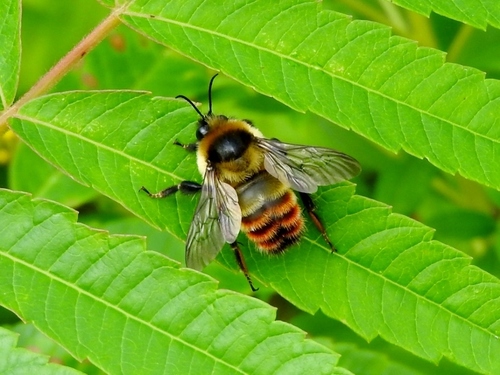
Red-belted Bumble Bee
Bombus rufocinctus
With its striking splash of orange and tireless work ethic, the Red-belted Bumble Bee is a late-summer favorite for backyard observers. This adaptable pollinator is a key player in keeping North American gardens vibrant and healthy.
Quick Identification
Size
Queens: 16–18 mm (0.6–0.7 in); Workers: 9–13 mm (0.35–0.5 in); Males: 11–13 mm (0.4–0.5 in)
Colors
Highly variable but usually features yellow on the thorax with a black central patch and a distinct reddish-orange 'belt' across the second and third abdominal segments. Workers and queens have black faces, while males often sport yellow facial hair.
Key Features
- Distinctive red or orange band on the middle of the abdomen
- Short, rounded face and square-shaped head
- Yellow thorax with a prominent black band or patch between the wing bases
- Compact, fuzzy body typical of North American bumble bees
When You’ll See Them
Behavior
The Red-belted Bumble Bee is a diligent and highly social pollinator known for its adaptability. Unlike many bumble bee species that have very specific habitat requirements, the Red-belted is a generalist that can thrive in environments ranging from high-altitude meadows to suburban backyards. They are 'short-tongued' bees, which means they prefer open, shallow flowers where they don't have to reach deep for nectar. This makes them frequent visitors to daisies, asters, and sunflowers.
These bees follow a classic annual colony cycle. A single queen emerges from hibernation in the spring, selects a nesting site—often in an old rodent burrow or a dense tuft of grass—and raises the first generation of worker bees alone. Once the workers take over foraging duties, the queen remains in the nest. By late summer, the colony produces new queens and males (drones) to ensure the next generation, making August and September the busiest time to spot them in your garden.
EverydayEarth exclusive
Camera Tips
To capture the Red-belted Bumble Bee on your backyard camera, you need to think small and fast. Unlike a deer or a fox, a bee will only occupy a tiny fraction of your frame unless you position your camera very close. Mount your camera on a small tripod or stake just 12 to 18 inches away from a 'target' flower patch. Native perennials like Purple Coneflower (Echinacea) or Black-eyed Susans are perfect targets because they have flat centers that encourage the bee to stay still for a few seconds while feeding.
Lighting is your best friend when filming insects. Position your camera so the sun is behind you or to the side, illuminating the bee's fuzzy coat. This highlights the red 'belt' that gives this species its name. If your camera settings allow, enable a high-speed trigger or a 'burst' photo mode. Because bumble bees move sporadically, having multiple frames increases your chance of getting that one perfectly sharp shot where the wings are visible but not blurred.
Late summer is the prime time for 'bee-watching' on camera. As the colony reaches its peak size in August, the traffic to your flower beds will increase significantly. Try to shield your target flowers from heavy wind using a garden screen or by choosing a sheltered corner of your yard; a swaying flower makes it nearly impossible for the AI to maintain focus and trigger a recording. For the most interesting footage, aim for the mid-morning hours when the bees are most active but the sun isn't so high that it creates harsh, washed-out shadows.
Similar Species
Species that look similar or are commonly confused with Red-belted Bumble Bee.
Frequently Asked Questions
Record Red-belted Bumble Bee at your habitat
Connect a camera to start building your own species record — AI identifies every visitor automatically.