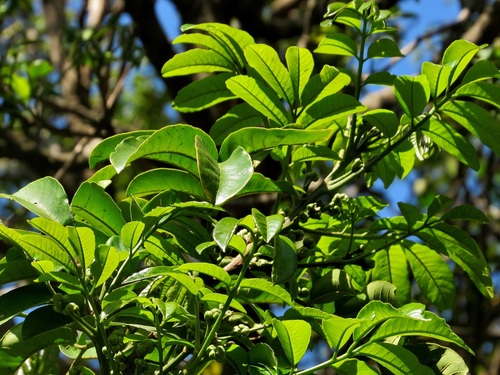
Forest Mahogany
Trichilia dregeana
A majestic giant of the mist-belt forest, the Forest Mahogany is a living sanctuary. Its glossy evergreen canopy and brilliant scarlet seeds make it the ultimate centerpiece for attracting exotic birds and shy forest mammals to your camera's view.
Quick Identification
Size
Height ranges from 10–30 meters (33–100 feet) with a canopy spread of up to 20 meters (65 feet)
Colors
Dark, glossy green leaves; creamy white to pale yellow flowers; velvety light-brown fruit capsules; bright scarlet seeds with a black spot
Key Features
- Large glossy leaves with 7–11 broad leaflets
- Round, woody seed capsules that split into 3-4 valves
- Distinctive scarlet-red seeds partially covered by a black aril
- Massive, spreading umbrella-shaped crown
When You’ll See Them
Behavior
The Forest Mahogany is a cornerstone species of the African evergreen forest, acting as both a physical anchor for the ecosystem and a vital food source. Unlike many trees that blend into the background, this species is a high-traffic hub for biodiversity. It produces a dense, dark shade that creates a cool microclimate beneath its canopy, often becoming a preferred resting spot for various ground-dwelling mammals during the heat of the day.
During its fruiting season, the tree undergoes a dramatic transformation. The woody capsules burst open to reveal striking red and black seeds. This event triggers a localized feeding frenzy among forest birds and monkeys. While the tree itself is stationary, its 'behavior' is defined by its interaction with the wind and the animals it feeds, showing a remarkable resilience to different soil types as long as moisture is abundant.
EverydayEarth exclusive
Camera Tips
Capturing the Forest Mahogany is less about the tree's movement and more about the incredible 'wildlife theater' that happens within its branches. To get the best results, position your camera at a height of 2 to 3 meters (6-10 feet) if you have a balcony or a slope that allows you to look into the mid-canopy. This is where the action is most intense during the fruiting season. If you are restricted to ground level, point your camera upward at a 45-degree angle toward a cluster of ripening fruit capsules.
The secret to great Forest Mahogany footage is timing your recording to coincide with the seed-split. Once the brown capsules open to reveal the scarlet seeds, set your AI camera to high-sensitivity motion detection. This will capture the arrival of specialized 'frugivores' like Trumpeter Hornbills, Knysna Turacos, and Purple-crested Turacos that are specifically attracted to the high-fat content of these seeds. For ground-based cameras, place the unit about 3 meters from the trunk to capture shy species like Blue Duiker or Bushbuck that scavenge for fallen seeds on the forest floor.
Lighting can be a challenge because the Mahogany's canopy is so dense. If your camera allows, adjust your exposure settings to account for high contrast—the bright sky through the leaves can often wash out the dark green foliage. Use a 'time-lapse' mode during the morning hours (7 AM to 10 AM) to capture the unfolding of the creamy flowers, which are highly fragrant and attract a wide variety of insect pollinators that in turn attract insectivorous birds.
During the dry season, the tree remains evergreen, making it a perfect backdrop for bird activity. If you want to capture more than just feeding, place your camera near a large horizontal branch. These are often used as 'highways' by Samango monkeys or thick-tailed bushbabies at night. Ensure your infrared flash is active, as the dense leaves can make for a very dark environment even on moonlit nights.
Similar Species
Species that look similar or are commonly confused with Forest Mahogany.
Frequently Asked Questions
Record Forest Mahogany at your habitat
Connect a camera to start building your own species record — AI identifies every visitor automatically.