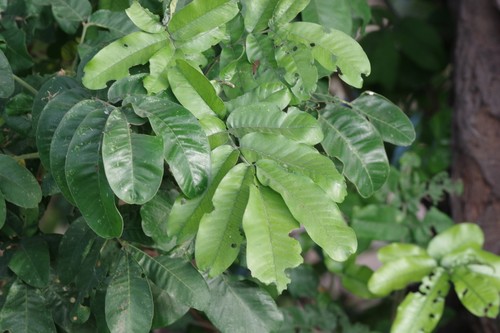
Natal mahogany
Trichilia emetica
An African icon, the Natal mahogany is a lush, evergreen giant that transforms any backyard into a bustling wildlife hub. From its honey-scented flowers to its vibrant 'Mickey Mouse' seeds, this tree is a magnet for the continent's most beautiful birds and mammals.
Quick Identification
Size
Height ranges from 8–20 meters (26–65 feet), with a canopy spread often reaching 15 meters (50 feet).
Colors
Glossy dark green foliage; grey to brownish-grey bark; creamy-green flowers; brownish-red fruit capsules with bright orange-red seeds.
Key Features
- Broad, spreading umbrella-shaped crown
- Dark green, glossy compound leaves with rounded tips
- Velvety, pear-shaped seed capsules that split into three valves
- Small, fragrant pale-yellow to green flowers
- Eye-catching orange seeds with a distinct black cap (aril)
When You’ll See Them
Behavior
The Natal mahogany is a majestic evergreen known for its dense, rounded canopy that provides deep shade in hot climates. While it appears stationary, it is a hive of biological activity. It acts as a keystone species in many African landscapes, offering a reliable food source and nesting site. Its sweet-scented flowers bloom between August and November, releasing a fragrance that can be detected from several meters away, specifically designed to attract nocturnal moths and diurnal bees.
As the seasons progress, the tree produces distinctive woody capsules. When these ripen, they split open to reveal strikingly bright seeds. This is a crucial moment for local wildlife; various bird species and monkeys are drawn to the oily arils. Humans have historically interacted with the tree for its medicinal bark and the rich oil extracted from the seeds, which is used in soaps and skin treatments. In a backyard setting, it is a fast-growing, non-invasive giant that creates a private sanctuary for both people and animals.
EverydayEarth exclusive
Camera Tips
To capture the true essence of a Natal mahogany, your camera strategy should focus on the visitors it attracts rather than just the tree itself. During the flowering months (August to November), mount your camera on a nearby branch or a sturdy pole roughly 2–3 meters high, angled toward a cluster of blossoms. Use a high-sensitivity trigger or a time-lapse setting to capture the wide variety of sunbirds and insects that visit for nectar. If you are using an AI-powered camera, ensure the 'Bird' or 'Insect' detection is prioritized during the morning hours when nectar production is at its peak.
When the seed capsules begin to split (usually in late summer), move your camera to capture the activity around the fruit. This is the best time to see Hornbills, Louries (Turacos), and Barbets. Because these birds can be skittish, a focal length that allows for some distance is ideal. If you have monkeys in your area, consider a wider angle to capture their social behavior as they forage in the canopy. Placement should be near the outer edges of the foliage where the fruit is most accessible and visible.
For those interested in the tree's growth, a long-term time-lapse is highly rewarding. Secure your camera to a permanent structure facing the south (in the Southern Hemisphere) to avoid lens flare, and set it to take one photo at noon every day. Over a year, you will see the magnificent transition of the canopy's density and the 'explosion' of the seed pods. Ensure your camera has a solar panel attachment, as the dense shade of a mature mahogany can quickly drain batteries that rely on ambient light if the panel is placed too deep within the branches.
Similar Species
Species that look similar or are commonly confused with Natal mahogany.
Forest Mahogany
The Forest Mahogany (Trichilia dregeana) has larger leaflets with more pointed tips and produces larger fruits that lack the distinct 'neck' found on Natal mahogany pods.
Cape Ash
Cape Ash (Ekebergia capensis) has similar glossy leaves, but its fruit is a fleshy, skin-covered berry rather than a woody capsule that splits open.
Frequently Asked Questions
Record Natal mahogany at your habitat
Connect a camera to start building your own species record — AI identifies every visitor automatically.