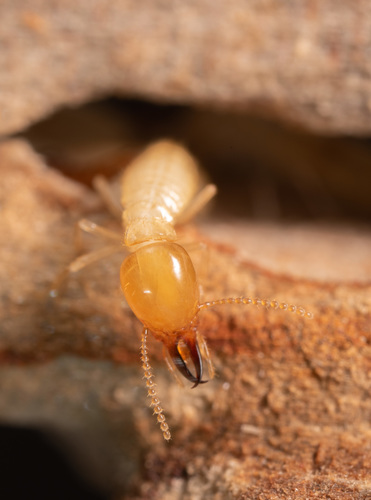
Formosan subterranean termite
Coptotermes formosanus
Meet the 'super-termite' of the insect world, a master builder capable of creating underground empires with millions of residents and spectacular evening swarms.
Quick Identification
Size
Workers: 3-4 mm (0.12-0.16 in); Soldiers: 4.5-6 mm (0.18-0.24 in); Alates (swarmers): 12-15 mm (0.5 in) including wings
Colors
Workers are creamy white to translucent; soldiers have pale bodies with distinct brownish-orange, oval-shaped heads; winged swarmers are yellowish-brown with translucent, hairy wings.
Key Features
- Oval-shaped soldier heads with a small pore (fontanelle) that secretes a white defensive fluid
- Densely hairy wings on winged reproductives (alates) during swarming
- Constructs elaborate 'mud tubes' to travel above ground while maintaining moisture
- Aggressive soldier caste with large mandibles that snap shut when disturbed
When You’ll See Them
Geographic range
Where Does the Formosan subterranean termite Live?
Native to southern China and Taiwan, the Formosan subterranean termite has become a global traveler due to its ability to survive in shipping crates and timber. It has established massive, invasive populations throughout the southeastern United States, Hawaii, and parts of South Africa and Japan. This species thrives in warm, humid subtropical climates, particularly in coastal regions and low-lying river basins where the soil remains consistently damp.
Basemap © OpenStreetMap contributors
Behavior
The Formosan subterranean termite is often referred to as a 'super-termite' because of its incredible colony size and destructive potential. Unlike many other termite species, a single Formosan colony can contain several million individuals and forage across an area of up to 300 feet. They are highly social, organized into a rigid caste system consisting of a king and queen, workers who gather food, and soldiers who defend the nest using chemical and physical warfare.
One of their most striking behaviors is the 'nuptial flight' or swarming. On warm, humid evenings in late spring or early summer, thousands of winged alates emerge from the colony simultaneously to find mates and establish new colonies. These swarms are often attracted to porch lights and windows, creating a visible spectacle that is often the first sign of an infestation for many homeowners.
Beneath the surface, these termites are master engineers. Because they are susceptible to desiccation (drying out), they build intricate mud tubes made of soil, saliva, and excrement. These tubes allow them to bridge the gap between the moist earth and wooden structures, effectively acting as protected highways that keep the colony hydrated while they forage for cellulose.
EverydayEarth exclusive
Camera Tips
Capturing the Formosan subterranean termite on an AI camera requires two different strategies depending on whether you want to see the swarm or their daily engineering. To capture the famous 'nuptial flight,' position your camera near an outdoor light source, such as a porch light or a bright LED garden lamp. These winged termites are highly phototactic and will congregate in the thousands around lights on humid nights in late spring. Use a wide-angle setting to capture the scale of the swarm or a macro lens if you want to see the individual wing movements.
For observing their building and foraging behavior, look for mud tubes on foundation walls, fence posts, or tree trunks. Mount your camera just a few inches from the tube, ideally using a tripod or a ground stake. Because these termites work slowly, time-lapse photography is your best tool. Setting your camera to take a photo every 5-10 minutes can reveal the incredible speed at which a colony can construct a mud tube or dismantle a piece of wood over several days.
Since much of their activity happens in the dark or in shaded areas, ensure your camera's infrared (IR) sensors are clean. The soft glow of IR is perfect for capturing the translucent bodies of the workers and soldiers without scaring them off with bright white light. If you want to lure them into view for a close-up, place a piece of damp, untreated pine or a thick layer of wet cardboard directly in front of the lens. Within a few weeks, you may be able to film the soldiers guarding the edges of the newly discovered food source.
Similar Species
Species that look similar or are commonly confused with Formosan subterranean termite.
Frequently Asked Questions
Record Formosan subterranean termite at your habitat
Connect a camera to start building your own species record — AI identifies every visitor automatically.