Eastern Subterranean Termite
Reticulitermes flavipes
The Eastern Subterranean Termite is North America's most industrious decomposer. Though small, these social insects build massive underground empires and play a crucial role in recycling the continent's forests.
Quick Identification
Size
Workers and soldiers: 3–5 mm (0.12–0.20 in); Alates (swarmers): up to 10 mm (0.4 in) including wings
Colors
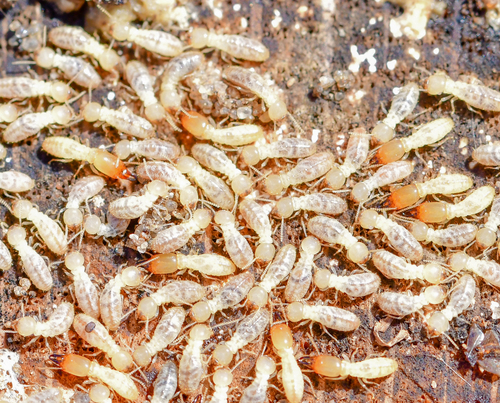
Workers are creamy-white; soldiers have amber heads; swarmers are dark brown to black with translucent wings
Key Features
- Soft, translucent milky-white bodies (workers)
- Rectangular, orange-brown heads with prominent mandibles (soldiers)
- Four identical, silvery-grey wings longer than the body (swarmers)
- Absence of a 'waist' between thorax and abdomen
When You’ll See Them
Geographic range
Where Does the Eastern Subterranean Termite Live?
Native to the North American continent, the Eastern Subterranean Termite is the most widespread termite species in the United States, spanning from the Atlantic coast through the Midwest and down into the Gulf of Mexico. While their heartland lies in the temperate and subtropical regions of the U.S. and southern Canada, they have successfully traveled abroad, establishing introduced populations in parts of Europe, South America, and even the Bahamas. These resilient insects thrive wherever there is moist soil and a steady supply of cellulose, making them a common sight in both wild forests and developed suburban neighborhoods.
Basemap © OpenStreetMap contributors
Behavior
Eastern Subterranean Termites are highly social insects that operate within a sophisticated caste system consisting of a queen, king, workers, soldiers, and reproductives. Unlike drywood termites, this species must maintain contact with the soil to stay hydrated, leading them to build intricate 'mud tubes' made of soil and saliva to bridge the gap between the ground and their food sources. They are the ultimate recyclers of the forest floor, breaking down fallen logs and woody debris into nutrient-rich soil.
While they are often viewed as pests due to their ability to damage human structures, their behavior is driven entirely by a search for cellulose. A single colony can forage over a wide area, sometimes extending up to half an acre. They communicate using pheromones and vibrations; soldiers will bang their heads against tunnel walls to alert the colony of potential threats from predators like ants.
EverydayEarth exclusive
Camera Tips
Capturing Eastern Subterranean Termites on camera requires a focus on their infrastructure or their rare appearances above ground. To see their daily work, place a camera with macro capabilities near active mud tubes on tree stumps or fallen logs. Position the lens just a few inches from the surface to capture the texture of the mud tubes. Because they avoid light, you won't see them 'out and about' unless the tube is breached or they are swarming.
The most dramatic footage occurs during 'swarming' events, usually on warm, humid mornings following spring rain. Set your camera to a high frame rate (60fps or higher) to capture the fluttering of the alates as they emerge by the thousands to find mates. Aim the camera at a known exit hole or a brightly lit window near a suspected colony, as swarmers are attracted to light once they emerge from the soil.
For a DIY science project, place a piece of damp cardboard or an untreated pine stake in a shady spot in your yard. Check it every few days; once you see the white workers underneath, set up a time-lapse camera to document how quickly they can break down the material. Use a camera with strong infrared (IR) capabilities, as much of their activity occurs in darkness or under cover where visible light would drive them back into their tunnels.
Similar Species
Species that look similar or are commonly confused with Eastern Subterranean Termite.
Frequently Asked Questions
Record Eastern Subterranean Termite at your habitat
Connect a camera to start building your own species record — AI identifies every visitor automatically.