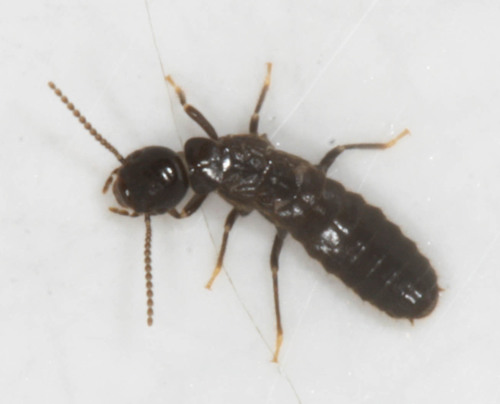
Western Subterranean Termite
Reticulitermes hesperus
The Western Subterranean Termite is a hidden architect of the underground world, essential for forest health but a challenge for homeowners. Witness their rare, dramatic swarming flights and discover the intricate mud-tube highways they build to survive.
Quick Identification
Size
Workers and soldiers measure 4.5–6 mm (0.18–0.24 inches); reproductive alates are approximately 10 mm (0.4 inches) including wings.
Colors
Workers are creamy-white; soldiers have pale bodies with large, rectangular orange-brown heads; reproductive swarmers are dark brown to coal-black with four translucent, smoky-gray wings.
Key Features
- Dark brown or black winged swarmers with two pairs of equal-length wings
- Soft-bodied, creamy-white workers without wings
- Soldiers with elongated orange heads and prominent dark mandibles
- Presence of earthen 'mud tubes' leading from soil to wood sources
When You’ll See Them
Geographic range
Where Does the Western Subterranean Termite Live?
Native to the western regions of North America, the Western Subterranean Termite is the most common termite species along the Pacific Coast. Its range extends from the southern reaches of British Columbia through Washington, Oregon, and California into Northern Mexico. While primarily a coastal and valley dweller, populations are also found further inland in parts of Idaho and Nevada, thriving wherever soil moisture and wood sources overlap.
Basemap © OpenStreetMap contributors
Behavior
Western Subterranean Termites are highly social insects that live in complex underground colonies. These societies are divided into a strict caste system consisting of a queen and king, sterile workers who forage for food and maintain the nest, and soldiers equipped with large mandibles to defend the colony against ants. Because they are highly susceptible to desiccation, they spend the majority of their lives in the humid environment of the soil or within the protective cover of the wood they are consuming.
To navigate above ground, they construct distinctive 'mud tubes' made of soil, saliva, and fecal matter. These tubes act as protected highways, maintaining the moisture levels the termites need to survive while shielding them from predators. While they are often viewed as pests due to their ability to damage wooden structures, they play a crucial ecological role in recycling dead wood into nutrient-rich soil.
The most visible interaction humans have with this species occurs during 'swarming' events. On warm, sunny days following a rain—typically in the spring or fall—hundreds of winged reproductives emerge from the colony simultaneously. These swarmers are weak fliers and quickly shed their wings once they find a mate and a suitable spot to begin a new underground colony.
EverydayEarth exclusive
Camera Tips
Capturing Western Subterranean Termites on camera requires a different strategy than photographing larger wildlife because they spend 99% of their time hidden. To catch the colony in action, focus your camera on 'mud tubes' found on garden stakes, fence posts, or tree trunks. Use a macro lens or a camera with a strong close-up capability. Since they are sensitive to light and vibrations, set your camera on a tripod and use a remote trigger or a timer to avoid disturbing them while they work.
The 'Holy Grail' for termite photography is the swarming event. These usually occur on the first warm, clear day following a significant rainfall. Keep your camera ready during the spring and fall months. Look for large numbers of black, winged insects emerging from cracks in the ground or wood. Because swarmers are attracted to light, you can often find them near windows or outdoor light fixtures. High-speed shutter settings are essential here to freeze the motion of their fluttering wings.
For a unique backyard project, try a time-lapse of a mud tube being constructed. If you find a broken tube, termites will move quickly to repair it to prevent moisture loss. Position your camera just a few inches away with a ring light or soft external flash to illuminate the interior of the tube. Set your interval to one frame every 30 seconds; you will be amazed at how quickly the workers transport soil pellets to seal the breach.
Avoid using heavy baits or lures that might harm the colony if your goal is purely observation. Instead, look for natural activity centers like old stumps or damp wood piles. If you are using an AI-powered camera, place it near ground level in a shaded, moist area of the garden. The movement of a mass swarming event is often enough to trigger motion sensors, but for individual workers, you will likely need a camera with a dedicated macro-focus mode.
Similar Species
Species that look similar or are commonly confused with Western Subterranean Termite.
Frequently Asked Questions
Record Western Subterranean Termite at your habitat
Connect a camera to start building your own species record — AI identifies every visitor automatically.