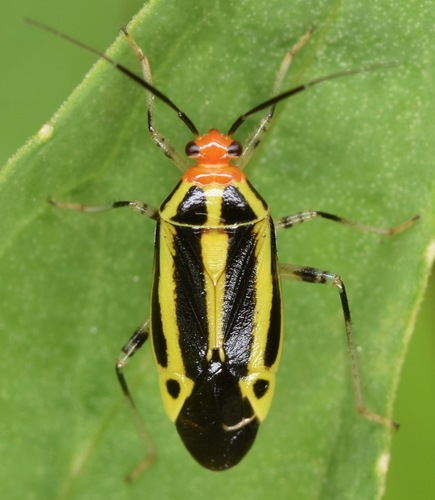
Four-lined Plant Bug
Poecilocapsus lineatus
With its neon-yellow body and bold 'racing stripes,' the Four-lined Plant Bug is one of the most striking—and fastest—insects in the summer garden. Watch closely as this tiny speedster darts across leaves in search of its next nectar-rich meal.
Quick Identification
Size
7–8.5 mm (0.28–0.33 inches) in length
Colors
Bright lime-green to lemon-yellow base color with four distinct black longitudinal stripes running down the wing covers; nymphs are a striking solid bright red or orange.
Key Features
- Four parallel black stripes on the wing covers
- Bright lime-green or yellow body
- Fast, skittish movement patterns
- Black antennae and legs
When You’ll See Them
Behavior
The Four-lined Plant Bug is an incredibly active and alert member of the Miridae family. Unlike many garden insects that move sluggishly, these bugs are remarkably quick to react to movement or shadows. When approached, they will often perform a lateral 'scoot' to the underside of a leaf or simply drop into the leaf litter to hide. This evasive behavior makes them a fun but challenging subject for backyard observers.
These bugs are primarily known for their unique feeding style. They use piercing-sucking mouthparts to inject saliva containing enzymes into plant leaves, which liquefies the plant cells. This results in characteristic 'stippling'—circular, sunken spots that turn brown or transparent. Because they are only active as adults for a short window in late spring and early summer, the damage they cause is usually aesthetic rather than life-threatening to the plant, and they seem to disappear as suddenly as they arrived.
EverydayEarth exclusive
Camera Tips
Capturing high-quality footage of the Four-lined Plant Bug requires a dedicated macro setup because of their small size and skittish nature. Place your AI camera or trail cam on a tripod just 4 to 8 inches away from a cluster of host plants, such as a mint patch or a flowering weigela bush. Manual focus is highly recommended if your camera allows it; lock the focus on the upper surface of a leaf where you've already noticed the characteristic brown stippling spots, as the bugs frequently return to previous feeding sites.
Because these insects are triggered by sudden movement, 'set it and forget it' is the best strategy. Use a high-frame-rate setting (60fps or higher) to capture their rapid scurrying movements without motion blur. Lighting is also vital; these bugs have a slightly reflective surface, so shooting in the bright but diffused light of a slightly overcast day or in the 'golden hour' of mid-morning will prevent harsh highlights from washing out the detail of their black stripes against their yellow bodies.
To increase your chances of a 'hit' on your camera, look for nymphs in early May. These are bright red and less likely to fly than the winged adults. If you find a cluster of red nymphs, position your camera there and wait for them to transition into their adult forms. Avoid using any garden sprays in the vicinity, as these bugs are highly sensitive to chemical residues. A healthy, well-watered herb garden is the ultimate natural lure for this species.
Similar Species
Species that look similar or are commonly confused with Four-lined Plant Bug.
Frequently Asked Questions
Record Four-lined Plant Bug at your habitat
Connect a camera to start building your own species record — AI identifies every visitor automatically.