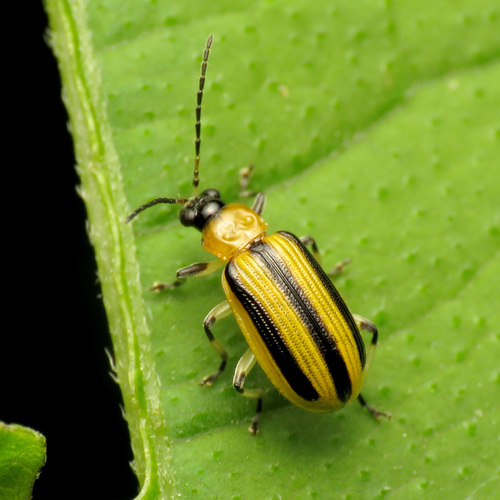
Striped Cucumber Beetle
Acalymma vittatum
A striking but notorious visitor to the vegetable patch, the Striped Cucumber Beetle is easily identified by its vibrant yellow body and bold racing stripes. While it looks charming through a macro lens, this little beetle is one of the most high-stakes challenges for any backyard gardener.
Quick Identification
Size
5-6 mm (0.2-0.25 inches) in length
Colors
Bright yellow wing covers (elytra) with three distinct black longitudinal stripes; black head and antennae; yellow legs with black 'knees' or joints.
Key Features
- Three bold black stripes running down a yellow back
- Black head and dark abdomen
- Small, oblong body shape
- Yellow legs with black tips
When You’ll See Them
Behavior
The Striped Cucumber Beetle is a highly specialized herbivore that spends its life cycle in and around gardens. Adults emerge in early spring, often before garden crops are even planted, surviving on the pollen of wild flowers and weeds. Once they locate a host plant—typically a cucumber, squash, or melon—they release aggregation pheromones that signal other beetles to join the feast. This social feeding behavior can lead to large populations appearing on a single plant overnight.
These beetles are not just passive eaters; they are active flyers and surprisingly wary. When they sense movement or a shadow, they often drop from the leaf and hide in the soil or thick foliage below. Their interaction with humans is primarily as a significant garden pest, known for transmitting bacterial wilt (Erwinia tracheiphila), a disease that can cause a healthy-looking vine to collapse and die within days.
EverydayEarth exclusive
Camera Tips
To successfully capture the Striped Cucumber Beetle on your backyard camera, you must focus on 'macro' placement. Because these beetles are only about 5 millimeters long, a standard trail camera positioned for large mammals will likely miss them. Use a camera with a dedicated macro lens or an AI-powered device capable of close-up focus, and position it roughly 6 to 10 inches away from a high-traffic area. The best 'stage' for your camera is the interior of a large, yellow squash blossom or the underside of a young cucumber leaf.
Timing is critical for these shots. These beetles are most active during the heat of the day when the sun is high. Set your camera to capture high-speed bursts or short video clips, as the beetles move quickly when feeding or searching for mates. Since they are attracted to the color yellow, you can actually use a yellow card or a bright yellow flower as a natural lure to keep them in the camera's frame longer. Avoid using heavy baits or lures that might attract larger scavengers that could knock your camera out of alignment.
If you are using a motion-triggered setup, ensure the sensitivity is set to maximum. Because the beetle’s mass is so small, it may not trigger PIR sensors reliably. A time-lapse mode set to take a photo every 30 seconds during peak daylight hours is often a more effective strategy for documenting their presence. Look for 'trap crops'—early season squash planted specifically to attract these beetles—as the ideal location for a permanent camera station during the late spring and early summer months.
Similar Species
Species that look similar or are commonly confused with Striped Cucumber Beetle.
Spotted Cucumber Beetle
Features 12 black spots on a yellowish-green back instead of three longitudinal stripes.
Western Striped Cucumber Beetle
Found west of the Rockies; features a much paler, almost white or gray background color instead of bright yellow.
Four-lined Plant Bug
Has four stripes instead of three and a more flattened, shield-like body shape compared to the beetle's oblong form.
Frequently Asked Questions
Record Striped Cucumber Beetle at your habitat
Connect a camera to start building your own species record — AI identifies every visitor automatically.