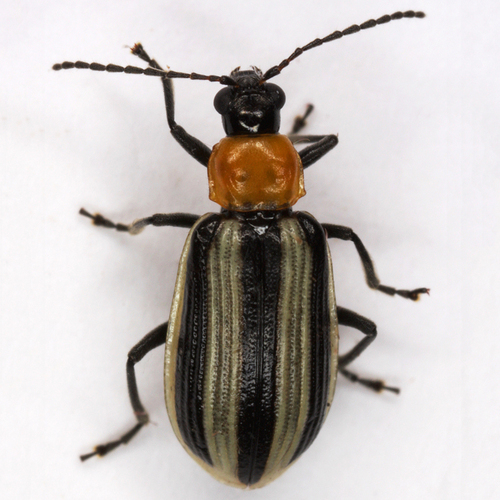
Western Striped Cucumber Beetle
Acalymma trivittatum
A striking but tiny visitor to the summer garden, the Western Striped Cucumber Beetle is easily identified by its bold racing stripes and its love for squash blossoms. While a challenge for gardeners, its vibrant contrast and active lifestyle make it a captivating subject for backyard macro-photography.
Quick Identification
Size
5-6 mm (0.2-0.24 inches) in length
Colors
Bright yellow to yellowish-green wing covers (elytra) with three prominent black longitudinal stripes; black head, antennae, and legs.
Key Features
- Three distinct black stripes running down the back
- Black legs and underside
- Yellow or yellowish-green base color
- Small, elongated oval body shape
When You’ll See Them
Behavior
The Western Striped Cucumber Beetle is a highly active and mobile insect, known primarily for its strong association with plants in the gourd family. Upon emerging from their winter dormancy in the soil or under garden debris, these beetles use their sensitive antennae to home in on the chemical signals released by host plants. They are often seen congregating in the large, yellow flowers of squash and pumpkins, where they feed on pollen and nectar while seeking out mates.
While they are solitary foragers, you will frequently find them in small groups on a single plant due to the concentrated food source. They are remarkably skittish; at the slightest vibration or shadow, they will either drop to the ground to hide in the soil or take flight with surprising speed. In addition to their feeding habits, they are known vectors for bacterial wilt, making them a significant focus for backyard gardeners and farmers alike.
EverydayEarth exclusive
Camera Tips
Capturing high-quality footage of the Western Striped Cucumber Beetle requires a dedicated macro setup due to their small size. Position your AI-powered camera within 6 to 12 inches of a host plant's flower. The large, bright yellow blossoms of zucchini or pumpkin plants act as a natural stage. Because these beetles are attracted to the color yellow, the flower itself serves as the perfect lure to bring them directly into your camera's field of view.
Lighting is the most critical factor for success. These beetles have a slightly glossy exoskeleton that can cause glare in direct midday sun. For the best results, set your camera to capture during the mid-morning hours (between 9 AM and 11 AM) when the light is bright but not overly harsh. This is also when the beetles are most active as they warm up for the day. If your camera allows for manual focus, lock it on the rim of a flower or the central stamen, as this is where the beetles spend the most time feeding.
To increase your chances of a sighting, avoid using broad-spectrum pesticides in the area, as these will deter or kill the beetles before you can film them. Instead, leave a few "trap plants" like Blue Hubbard squash, which are irresistible to this species. Mounting your camera on a small, flexible tripod or a garden stake will allow you to get the low angle needed to see the beetle's face and stripes clearly. If your camera has a high-speed trigger, enable it; these insects are fast movers and can fly out of frame in a fraction of a second.
Consider a time-lapse setting during the peak of summer. Setting your camera to take a photo every 30 seconds can reveal the fascinating way these beetles interact with one another and the plant throughout the day. You might even catch them emerging from the soil at the base of the plant in the early morning or retreating into the safety of the foliage as the sun begins to set.
Similar Species
Species that look similar or are commonly confused with Western Striped Cucumber Beetle.
Striped Cucumber Beetle
Very similar but typically has a yellow or orange abdomen and pale leg segments, whereas the Western species has entirely black legs and a black underside.
Western Corn Rootworm
Has similar yellow and black coloring but the stripes are often less defined or appear more as smudges, and it is more commonly found on corn plants.
Frequently Asked Questions
Record Western Striped Cucumber Beetle at your habitat
Connect a camera to start building your own species record — AI identifies every visitor automatically.