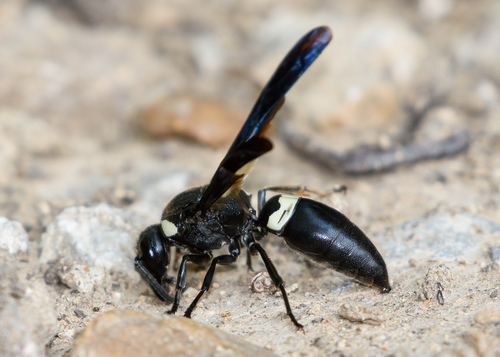
Four-toothed Mason Wasp
Monobia quadridens
With its sleek black armor and striking ivory band, the Four-toothed Mason Wasp is a master architect of the backyard. This solitary hunter is a fascinating, non-aggressive neighbor that helps keep garden caterpillar populations in check.
Quick Identification
Size
Body length of 12-18 mm (0.47-0.71 in); wingspan up to 18 mm (0.71 in)
Colors
Jet black body with a single prominent ivory or white band on the first abdominal segment; wings are dark smoky-brown with a metallic blue-violet iridescence; males have a white patch on their face.
Key Features
- Solid black body with a single creamy-white band
- Dark wings with a metallic blue-purple sheen
- Large, prominent mandibles
- Solitary behavior around wooden structures or hollow stems
When You’ll See Them
Behavior
The Four-toothed Mason Wasp is a solitary species, meaning it does not live in a colony with a queen or workers. Unlike social wasps, they are remarkably docile and rarely sting humans unless physically handled. You will most often observe them investigating narrow crevices in wood, hollow plant stems, or even abandoned nests of other bees. The females are master engineers, using mud to create partitions within these cavities to house their offspring.
A fascinating aspect of their behavior is their role as a natural pest controller. Females hunt small caterpillars, paralyzing them with a sting before dragging them back to the nest. They stuff several paralyzed caterpillars into a cell to serve as a fresh food source for their larvae. Despite their somewhat intimidating appearance, they are beneficial garden residents that play a dual role as both pollinators and predators.
EverydayEarth exclusive
Camera Tips
To capture high-quality footage of the Four-toothed Mason Wasp, focus your AI camera on 'bee hotels' or wooden structures with pre-drilled holes ranging from 1/4 to 3/8 inches in diameter. These wasps are frequently seen inspecting these cavities for potential nesting sites. Mount your camera on a tripod approximately 12–18 inches away from the nesting site to allow the lens to focus on the fine details of the wasp's ivory band and iridescent wings. Using a macro lens or a camera with a close-focusing distance is highly recommended for this species.
Another excellent strategy is to position your camera near nectar-rich flowers such as Goldenrod, Milkweed, or Mountain Mint. These are preferred refueling stations for adults. Because these wasps move with quick, jerky motions, set your camera to a high frame rate (at least 60 fps) to avoid motion blur. If your camera has a 'pre-roll' or 'buffer' feature, enable it; these wasps often land and take off within seconds, and you don’t want to miss the arrival or departure.
Pay attention to the lighting. The deep black body of the Four-toothed Mason Wasp can easily lose detail in harsh midday sun, appearing as a dark silhouette. Positioning your camera so the sun is at a 45-degree angle to the subject will help highlight the metallic blue sheen on the wings. In late summer, keep an eye out for females carrying paralyzed caterpillars—this is the 'holy grail' shot for backyard wildlife enthusiasts and is most common during the warmer afternoon hours.
Similar Species
Species that look similar or are commonly confused with Four-toothed Mason Wasp.
Frequently Asked Questions
Record Four-toothed Mason Wasp at your habitat
Connect a camera to start building your own species record — AI identifies every visitor automatically.