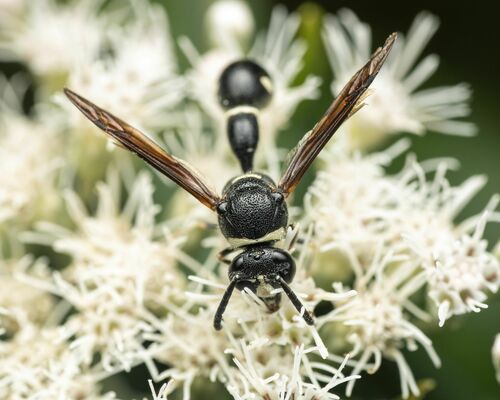
Fraternal Potter Wasp
Eumenes fraternus
A master mason of the garden, the Fraternal Potter Wasp crafts delicate mud jugs that are as functional as they are beautiful. These gentle, solitary wasps are a gardener's best friend, quietly hunting caterpillars while pollinating summer blooms.
Quick Identification
Size
Body length of 13–20 mm (0.5–0.8 inches); wingspan approximately 20–25 mm (0.8–1.0 inches)
Colors
Deep black body with ivory to creamy-white markings; white bands on the abdomen and small white spots on the thorax
Key Features
- Extremely narrow, elongated 'waist' (petiole)
- Bell-shaped second abdominal segment
- Deep black body with ivory-white accents
- Builds distinctive marble-sized mud pots for nests
When You’ll See Them
Behavior
The Fraternal Potter Wasp is a solitary insect known for its extraordinary architectural skills. Unlike social wasps like yellowjackets, the potter wasp works alone. The female spends her days meticulously gathering mud and mixing it with saliva to create small, vase-like structures on twigs, stems, or even the sides of buildings. These 'pots' are remarkably symmetrical, often featuring a flared rim that resembles a piece of fine stoneware.
Despite their somewhat intimidating appearance, Fraternal Potter Wasps are exceptionally docile and rarely show aggression toward humans. They do not guard their nests like social wasps do. Once a female has completed a pot, she lays a single egg inside, suspended by a silk thread, and then stocks the chamber with paralyzed caterpillars to serve as a fresh food source for her developing larva. Once the pot is sealed, her parental duties are finished.
EverydayEarth exclusive
Camera Tips
Capturing the Fraternal Potter Wasp on camera requires focusing on their 'construction sites' or 'foraging hubs.' Look for their distinctive mud pots on sturdy plant stems or the undersides of wooden porch railings. If you find an active construction site, mount your camera on a tripod just 12–18 inches away. Because these wasps are small and fast, use a camera with a dedicated macro mode or a high-speed sensor. A trigger speed of 0.2 seconds or faster is ideal to catch them as they land with a fresh ball of mud.
To lure them into view, you don't need traditional bait. Instead, provide habitat resources. During dry spells, a shallow dish filled with wet clay or mud will become a popular 'quarry' for females gathering building materials. Additionally, planting nectar-rich native flowers like Goldenrod, Rattlesnake Master, or Spiraea will keep them lingering in your camera's field of view. Position your camera so the sun is behind it; the bright light will highlight the ivory bands against their black bodies, making identification much easier in post-processing.
For the best results, use 'Burst Mode' or high-frame-rate video (60fps or higher). The most compelling footage often occurs when the wasp is hovering at the mouth of its mud pot or when it is struggling to maneuver a paralyzed caterpillar into the narrow opening. Set your camera for daytime-only operation to conserve battery, as these wasps are strictly diurnal and will be completely inactive once the sun goes down.
Similar Species
Species that look similar or are commonly confused with Fraternal Potter Wasp.
Frequently Asked Questions
Record Fraternal Potter Wasp at your habitat
Connect a camera to start building your own species record — AI identifies every visitor automatically.