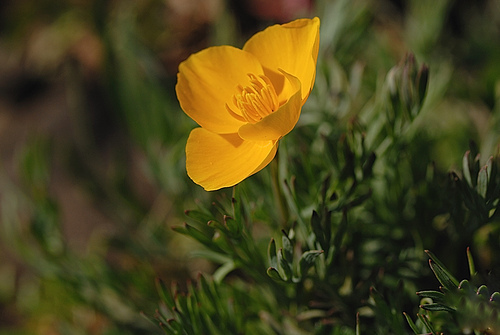
Frying Pans
Eschscholzia lobbii
Meet the Frying Pans, a petite and cheerful California native that turns sun-drenched foothills into a golden mosaic every spring.
Quick Identification
Size
Stalks reach up to 15 cm (6 in) tall; petals are approximately 1 cm (0.4 in) long
Colors
Bright lemon-yellow to light orange petals; pale green to bluish-green segmented foliage
Key Features
- Small yellow poppy flowers shaped like miniature 'frying pans' when open
- Erect, leafless flower stalks rising from a basal tuft
- Finely divided, needle-like green leaves
- Petals lack the fleshy 'rim' found at the base of California Poppies
When You’ll See Them
Behavior
Frying Pans are ephemeral annual wildflowers that follow a strict seasonal clock. Emerging after the first significant winter rains in California, they spend their early life as a low-lying rosette of foliage, gathering energy for a sudden spring explosion. Unlike many garden plants, they are highly sensitive to the movement of the sun. Their blooms are nyctinastic, meaning they tightly fold their petals at night and during overcast weather to protect their pollen, only unfurling into their signature flat 'pan' shape when the sun is high and warm.
In the wild, these plants often grow in colonies, creating a shimmering yellow carpet across grassy slopes. They don't 'behave' in a social sense, but they are vital hubs of activity for the local insect community. Because they bloom relatively early in the spring, they serve as a critical early-season food source for native solitary bees and hoverflies, which are attracted to the bright UV-reflective properties of the yellow petals.
EverydayEarth exclusive
Camera Tips
To successfully capture Frying Pans on a trail camera, you must change your perspective. Because these poppies rarely exceed six inches in height, a standard eye-level or waist-high camera mount will completely miss them. Secure your camera to a short garden stake or a specialized ground mount just 4 to 6 inches above the soil. Aim the lens slightly upward to catch the underside of the yellow petals against the sky, or level with the blooms to show the 'carpet' effect of the colony. Using a camera with a macro lens or a close-focusing distance is essential, as the flowers themselves are only about the size of a thumbnail.
Lighting is your most important setting for this species. Since Frying Pans close up when it is dark or cloudy, your camera's motion sensors may not trigger as effectively on the 'still' closed buds. Set your camera to 'Time-Lapse' mode during the daylight hours, specifically between 9:00 AM and 5:00 PM. Taking an image every 15 to 30 minutes will allow you to create a stunning sequence of the flowers 'waking up' as the sun hits them. Avoid using a flash at night, as the plants will be closed and look like small, inconspicuous green spikes; the true beauty of this species is found in natural, bright sunlight.
Location placement is key to getting a clear shot without false triggers. Clear away any tall, dried stalks of last year's grasses that might blow in the wind and obscure the poppy patch. If you are using an AI-powered camera, position it near a cluster of blooms rather than a single flower to increase the chances of the software identifying the distinct color and shape. Because these plants grow in the open, they are often subject to wind; choose a calm day for the best clarity, or increase your shutter speed if your camera settings allow to avoid 'motion blur' from the swaying stalks.
Similar Species
Species that look similar or are commonly confused with Frying Pans.
Frequently Asked Questions
Record Frying Pans at your habitat
Connect a camera to start building your own species record — AI identifies every visitor automatically.