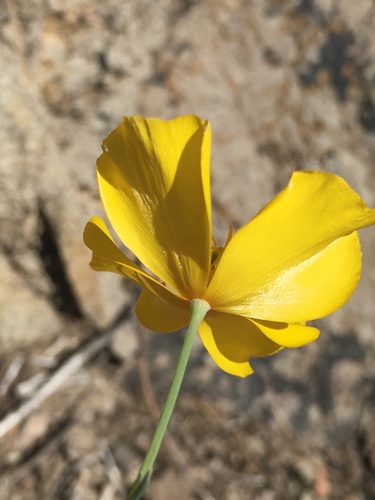
Tufted Poppy
Eschscholzia caespitosa
A delicate herald of spring, the Tufted Poppy blankets foothills in shades of brilliant lemon-yellow. Smaller and more refined than the common California Poppy, this 'collarless' beauty is a favorite for pollinators and backyard time-lapse photographers alike.
Quick Identification
Size
Height: 5–30 cm (2–12 inches); Flower diameter: 1–2.5 cm (0.4–1 inch)
Colors
Bright lemon-yellow to golden-yellow petals; foliage is a soft bluish-green or glaucous green
Key Features
- Finely divided, lace-like leaves forming a basal tuft
- Clear yellow petals lacking the orange center often seen in relatives
- Absence of a fleshy 'collar' or rim at the base of the flower
- Narrow, upright seed pods reaching 4-8 cm in length
When You’ll See Them
Behavior
The Tufted Poppy is a charming annual wildflower that exhibits nyctinasty, a fascinating biological rhythm where the petals fold upward and close tightly every evening, only to unfurl again as the morning sun hits them. This behavior protects the pollen from moisture and ensures it remains available for the specific insects that visit during the heat of the day.
As a spring ephemeral, its lifecycle is rapid. It germinates quickly after winter rains, blooms in a sudden burst of yellow to attract pollinators, and produces seed pods that eventually 'explode' or split to scatter seeds for the next generation. It does not possess the aggressive spreading nature of some perennials, preferring to grow in tidy, isolated tufts—hence its common name.
EverydayEarth exclusive
Camera Tips
To capture the stunning transformation of the Tufted Poppy, set your camera to time-lapse mode rather than motion-triggering. Because plants move slowly, a motion sensor won't catch the 'action' of the bloom. We recommend an interval of one frame every 5 to 10 minutes from sunrise to late afternoon. This will allow you to create a smooth video showing the petals unfurling in the morning light and closing back up as the temperature drops.
Since these poppies are low-growing, your camera should be mounted very close to the ground, ideally on a mini-tripod or a ground stake. Angle the lens slightly upward to catch the underside of the petals, which often glows beautifully when backlit by the sun. Avoid placing the camera too close (stay outside the minimum focal distance, usually 12-18 inches) to ensure the delicate textures of the 'tufted' foliage remain in sharp focus.
For those interested in 'backyard' wildlife interactions, position your camera to face a cluster of poppies that are in direct sunlight. These flowers are magnets for solitary bees and small hoverflies. Using a high-speed shutter setting (1/1000 or faster) within your camera's manual options will help freeze the motion of these fast-moving pollinators as they land on the yellow petals.
Keep in mind the 'Golden Hour' effect. While the flowers are most open at midday, the harsh overhead sun can wash out the bright yellow color. The best footage is often captured in the two hours after sunrise or the two hours before sunset, when the light is warm and soft, accentuating the fine, hair-like divisions of the leaves and the satiny texture of the blooms.
Similar Species
Species that look similar or are commonly confused with Tufted Poppy.
Frequently Asked Questions
Record Tufted Poppy at your habitat
Connect a camera to start building your own species record — AI identifies every visitor automatically.