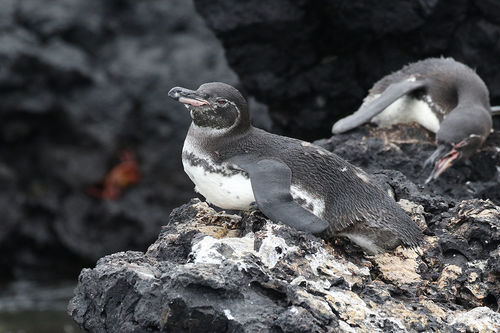
Galápagos Penguin
Spheniscus mendiculus
The only penguin species to cross into the Northern Hemisphere, the Galápagos Penguin is a resilient island dweller that thrives where the tropics meet the deep chill of the Pacific.
Quick Identification
Size
49-53 cm (19-21 in) tall; weight 2-2.5 kg (4.4-5.5 lbs)
Colors
Black back and head; white belly; thin white line looping from eye to chin; black chest band
Key Features
- Only penguin found north of the equator
- Smallest of the Spheniscus 'banded' penguins
- Thin, horseshoe-shaped black band on chest
- Pinkish patches of bare skin around the eyes and bill base
When You’ll See Them
Geographic range
Where Does the Galápagos Penguin Live?
Native to the South American region, the Galápagos Penguin is uniquely endemic to the Galápagos Islands of Ecuador. This species holds the title of the only penguin to naturally occur in the Northern Hemisphere, with the majority of the population residing on Isabela and Fernandina Islands. Their survival in this tropical zone is entirely dependent on the cool, nutrient-rich upwellings of the surrounding Pacific currents.
Basemap © OpenStreetMap contributors
Behavior
Galápagos Penguins are remarkably social birds that have adapted to one of the most unusual environments for a penguin: the tropical equator. To survive the heat, they spend the majority of their daylight hours in the cool waters of the Cromwell and Humboldt currents. On land, they exhibit fascinating cooling behaviors, such as panting like dogs and standing with their flippers extended to radiate heat from their featherless underarms.
These penguins are monogamous and form deep pair bonds that often last a lifetime. Unlike their Antarctic cousins, they don't have a fixed breeding season; instead, they breed whenever the ocean temperature drops and food becomes plentiful. When they aren't hunting, they can be found preening one another near rocky crevices, which serves both to maintain their waterproof feathers and to reinforce social connections within the colony.
EverydayEarth exclusive
Camera Tips
Capturing the Galápagos Penguin on a trail camera requires targeting the specific 'landing' spots where they exit the water. Look for smooth, flat volcanic rocks that show signs of frequent use, such as guano deposits. Position your camera at a very low height—about 10 to 15 inches off the ground—to capture an eye-level perspective of these small birds. A slight upward tilt can help emphasize their stature and capture the distinct facial markings that AI models use for species identification.
Because the equatorial sun is incredibly harsh, your camera's placement is critical to avoid 'blown-out' highlights on the penguin's white belly. Whenever possible, set up cameras in shaded alcoves or facing away from the direct midday sun. If your camera has adjustable exposure settings, dialing it down by -0.5 or -1.0 can help preserve the detail in their feathers. Early morning and late afternoon provide the best natural lighting, as the birds are most active when returning from or leaving for fishing trips.
Motion sensitivity should be set to 'High' because penguins move in quick, jerky hops when traversing rocky terrain. Use a fast trigger speed to ensure you don't just catch a tail disappearing out of the frame. Since these penguins are highly sensitive to environmental disturbances and are legally protected, never use food lures or scents. Instead, focus your lens on the narrow gaps between rocks that act as natural funnels toward their nesting caves, which will naturally guide the penguins into your camera's field of view.
Similar Species
Species that look similar or are commonly confused with Galápagos Penguin.
Frequently Asked Questions
Record Galápagos Penguin at your habitat
Connect a camera to start building your own species record — AI identifies every visitor automatically.