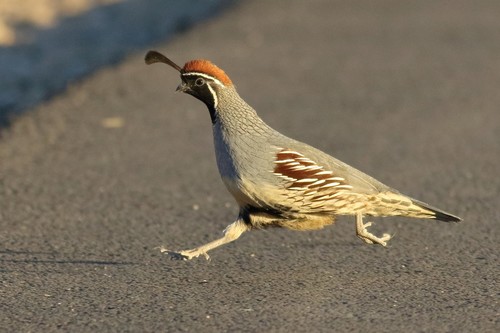
Gambel's Quail
Callipepla gambelii
The iconic 'top-knotted' socialite of the American Southwest, Gambel's Quail are famous for their scurrying coveys and distinctive 'chi-ca-go-go' calls.
Quick Identification
Size
Length: 9.4–11.4 in (24–29 cm); Wingspan: 13.4–14.2 in (34–36 cm); Weight: 5.6–7.1 oz (160–200 g)
Colors
Males have a copper crown, black face mask with white border, and a black belly patch. Females are duller gray-brown without the black mask or belly patch. Both feature a black, teardrop-shaped head plume.
Key Features
- Forward-leaning, teardrop-shaped black head plume
- Striking black face mask bordered by white (males)
- Creamy belly with a distinct black patch (males)
- White-streaked rufous (reddish-brown) flanks
When You’ll See Them
Sightings on EverydayEarth
Jun 13, 2026
A male Gambel's Quail and a Song Sparrow are seen visiting a rocky birdbath. The quail takes a few drinks from the center of the pool before hopping up onto the surrounding rocks and moving out of view. The Song Sparrow remains on the left edge of the basin, cautiously moving around the water's perimeter.
Jun 12, 2026
A Gambel's Quail perches on the rocky perimeter of a stone water basin, keeping watch over the area. Meanwhile, a small songbird briefly lands in the center of the shallow water to drink and bathe before flying off.
Jun 12, 2026
A group of Gambel's Quail cautiously approaches a small, mossy water basin. They move with characteristic head-bobbing motions across the rocky ground, pausing to survey the surrounding desert scrub before settling near the water's edge to drink.
Apr 29, 2026
A male Gambel's Quail perches alertly on a dry branch amidst a thicket of desert scrub, surveying the area.
Geographic range
Where Does the Gambel's Quail Live?
Gambel's Quail are native to the arid regions of the Southwestern United States and Northwestern Mexico. Their core range is centered in the Sonoran Desert of Arizona and the Mojave Desert of California and Nevada, though they also thrive in parts of New Mexico, Utah, and Texas. They are strictly non-migratory residents, remaining in the same general territory throughout their lives.
Basemap © OpenStreetMap contributors
Behavior
Gambel's Quail are quintessential desert ground-dwellers, far more likely to be seen scurrying across a dusty trail than flying. They are highly gregarious birds, forming social groups called coveys that typically range from 12 to 40 individuals outside of the breeding season. Within these groups, they maintain a complex social hierarchy and communicate through a variety of calls, most notably the loud, four-syllable 'chi-ca-go-go' assembly call.
These birds are masters of desert survival, often timing their breeding seasons to coincide with winter rainfall that ensures a bounty of green sprouts and insects for their chicks. In suburban environments, they are remarkably bold, often marching through backyards in single-file 'parades.' However, they remain vigilant; you will often see a 'sentinel' male perched on a high fence or cactus, scanning for hawks while the rest of the covey feeds below.
EverydayEarth exclusive
Camera Tips
To capture the best footage of Gambel's Quail, ground-level camera placement is essential. Mount your camera no more than 6 to 12 inches off the ground, ideally near a 'dusting' spot or a low-profile water basin. These birds are extremely routine-oriented; if you see them in your yard at 8:00 AM once, they are likely to return at the same time tomorrow. Use a wide-angle setting to capture the entire covey, as seeing 20 birds move together is much more impressive than a single close-up.
Baiting is highly effective for this species. A small pile of cracked corn, white proso millet, or a standard wild bird seed mix scattered directly on the ground will keep them in the camera's field of view for several minutes. Because they move with quick, jerky motions, set your camera to a fast trigger speed and use 'Photo + Video' mode or a high-frame-rate video setting to avoid motion blur. Avoid placing the camera in deep shade, as the high contrast of the desert sun can make it difficult to see the fine details of their plumage.
Water is the ultimate draw in the desert. A ground-level birdbath or a simple shallow dish of water will attract every quail in the neighborhood, especially during the dry months of May and June. If your camera has a 'Time Lapse' feature, try setting it during the early morning hours (sunrise to 9 AM) to document the arrival of various coveys. During the spring, keep an eye out for 'parades' of tiny, fuzzy chicks—they are incredibly photogenic but move very fast, so burst mode is your best friend.
Similar Species
Species that look similar or are commonly confused with Gambel's Quail.
Frequently Asked Questions
Record Gambel's Quail at your habitat
Connect a camera to start building your own species record — AI identifies every visitor automatically.