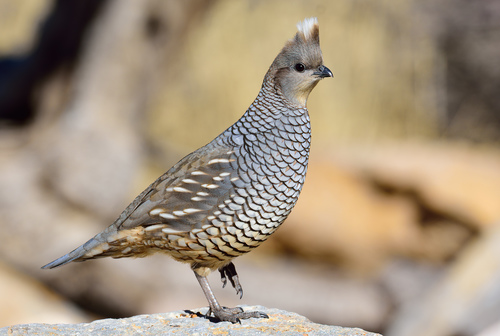
Scaled Quail
Callipepla squamata
Meet the 'Cottontop' of the desert. With its iconic white crest and beautiful 'scaly' plumage, the Scaled Quail is a master of camouflage and a world-class sprinter of the American Southwest.
Quick Identification
Size
Length: 10-12 in (25-30 cm); Wingspan: 14-15 in (35-38 cm); Weight: 5.3-7.1 oz (150-200 g)
Colors
Bluish-gray body with black-edged feathers creating a scaly appearance; white-tipped crest; buff-colored belly and throat.
Key Features
- Distinctive 'scaly' feather pattern on neck and chest
- Prominent white-tipped head crest (the 'cottontop')
- Short, thick bill and sturdy legs built for running
- Pale buff or yellowish throat patch
When You’ll See Them
Behavior
The Scaled Quail is a quintessential bird of the arid Southwest, often recognized more by its rapid footwork than its flight. Unlike many other quail species that take to the air at the first sign of danger, the Scaled Quail prefers to outrun its predators, darting between cacti and mesquite with surprising speed. They are highly social birds, particularly in the winter months when they form large groups known as 'coveys,' which can number from a dozen to over sixty individuals.
These birds are master communicators, using a variety of clucks and a distinctive 'whok-gosh' call to keep the covey together while foraging. In the spring, the social structure shifts as pairs form for the breeding season. You will often see a 'sentinel' bird perched on a fence post or a low rock, keeping a watchful eye for hawks or coyotes while the rest of the group feeds on the ground below. Their interaction with humans is generally cautious; they are shy birds that rely on their 'scaly' camouflage to blend into the desert floor.
EverydayEarth exclusive
Camera Tips
To capture the best footage of Scaled Quail, you must think like a ground-dweller. Since these birds spend the vast majority of their time walking and running, mount your camera very low—roughly 6 to 12 inches off the ground. Aiming the camera across a flat, open patch of dirt near heavy brush is ideal. These birds love 'dusting' to keep their feathers clean, so if you find a shallow depression of fine soil, that is a prime location for a camera trap.
Water is the single most effective lure for Scaled Quail in their dry environments. A low-profile birdbath or even a steady drip onto a flat stone will attract every covey in the neighborhood. If you are using food to attract them, scatter scratch grain or cracked corn near the edges of dense cover like a brush pile or thick shrubbery. They are hesitant to cross large open spaces, so keeping the 'stage' close to safety will result in longer, more relaxed visits in front of the lens.
Timing and settings are critical for this species. They are most active during the cool 'golden hours' of early morning and late afternoon. Set your camera to a fast trigger speed—ideally under 0.4 seconds—because they move quickly and can easily blur or exit the frame before the shutter fires. Using a high-frame-rate video setting (60fps) is excellent for capturing the rapid, rhythmic movement of their legs as they scurry.
In the winter, look for 'loafing' areas where the covey gathers to rest during the heat of the day. These are usually shaded spots under dense mesquite or overhanging rocks. Placing a camera here can capture fascinating social interactions, such as preening and huddling. During the spring, listen for the male's piercing call and look for them perching on higher vantage points like fence posts, which are great spots for a second camera angled slightly upward.
Similar Species
Species that look similar or are commonly confused with Scaled Quail.
Gambel's Quail
Gambel's has a dark, forward-leaning head plume (topknot) and lacks the overall 'scaled' feather appearance.
California Quail
California Quail have a similar scaly belly but feature a dark, teardrop head plume and are typically found further west.
Northern Bobwhite
Bobwhites lack the prominent crest and have more intricate brown, black, and white streaking rather than distinct scales.
Frequently Asked Questions
Record Scaled Quail at your habitat
Connect a camera to start building your own species record — AI identifies every visitor automatically.