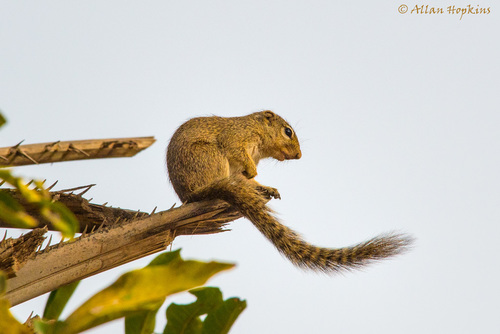
Gambian Sun Squirrel
Heliosciurus gambianus
Meet the Gambian Sun Squirrel, the acrobatic sun-worshiper of the African savanna. With its strikingly ringed tail and grizzled coat, this agile rodent is a master of the treetops and a frequent visitor to rural gardens across Sub-Saharan Africa.
Quick Identification
Size
Total length 35–52 cm (14–20.5 in); weight 250–350 g (8.8–12.3 oz)
Colors
Grizzled olive-grey to brownish-grey upperparts with yellowish flecks; cream to white underparts; tail features 14 or more alternating dark and light rings
Key Features
- Long, bushy tail with distinct dark rings
- Grizzled olive-grey fur with yellowish flecks
- Pale white or cream underside
- Arboreal habit with frequent sun-basking behavior
When You’ll See Them
Geographic range
Where Does the Gambian Sun Squirrel Live?
Native to the African continent, the Gambian Sun Squirrel occupies a massive belt across Sub-Saharan Africa, stretching from the Atlantic coast of Senegal and Gambia all the way to the highlands of Ethiopia and Kenya. Its presence is most robust in the wooded savannas and open forest mosaics of West and Central Africa, where it has adapted successfully to agricultural landscapes and rural settlements.
Basemap © OpenStreetMap contributors
Behavior
The Gambian Sun Squirrel is a classic sun-lover, frequently observed basking on horizontal branches in the early morning to warm its body before beginning its daily foraging. Unlike many skittish rodents, these squirrels are relatively bold in wooded savannas, moving with incredible agility through the canopy while using their long, ringed tails for balance. While they are primarily arboreal, they frequently descend to the forest floor to scavenge for fallen seeds, nuts, or insects.
They are mostly solitary or seen in pairs, though several individuals may gather in a single large fruiting tree. They are known for their vocal nature, emitting sharp, bird-like chirps and whistles to alert others of predators or to defend their immediate feeding territory. In areas near human settlements, they adapt well to gardens and orchards, often becoming quite familiar with human activity as long as they have a quick escape route to the trees.
EverydayEarth exclusive
Camera Tips
To capture the Gambian Sun Squirrel, place your camera roughly 1.5 to 2 meters (5-6 feet) up a tree trunk, ideally one with rough bark or thick horizontal branches where they like to sun themselves. These squirrels are very active in the vertical plane, so angling the camera slightly downward from a neighboring branch can provide a great view of their foraging behavior on the trunk or large limbs. Look for trees with visible hollows or dense creepers, as these are preferred nesting sites.
Baiting is highly effective for these curious rodents. A small platform feeder or a mesh bag filled with peanuts, sunflower seeds, or chunks of local fruit like mango or oil palm nuts will keep them in the frame long enough for a clear shot. Since they are diurnal and move with quick, jerky motions, ensure your camera's trigger speed is set to the fastest possible setting (0.2s - 0.5s) to avoid capturing just a tail as they dart away.
The best time for high-quality footage is mid-morning, shortly after the sun has cleared the horizon. This species loves 'sun-bathing' on exposed branches to regulate their temperature, which provides excellent natural lighting for your camera. Avoid placing the camera facing directly into the morning sun to prevent lens flare; instead, aim for side-lighting to highlight the grizzled texture of their fur and the distinct rings on their tails. If you are in a garden setting, placing the camera near a water source or a birdbath is also a reliable way to catch them during the hotter parts of the day.
Similar Species
Species that look similar or are commonly confused with Gambian Sun Squirrel.
Frequently Asked Questions
Record Gambian Sun Squirrel at your habitat
Connect a camera to start building your own species record — AI identifies every visitor automatically.