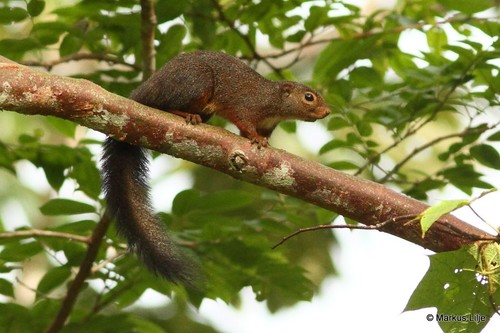
Red-legged Sun Squirrel
Heliosciurus rufobrachium
A vibrant acrobat of the African canopy, the Red-legged Sun Squirrel is easily identified by its rusty-colored limbs and its love for basking in the equatorial sun. This resilient rodent thrives high above the forest floor, bridging the gap between the dense rainforests of the West and the montane woodlands of the East.
Quick Identification
Size
Head and body length of 20-30 cm (8-12 in), tail length of 20-30 cm (8-12 in), weighing approximately 250-400 g (9-14 oz)
Colors
Olive-brown or grizzled grey upperparts; creamy-white or pale yellow underparts; distinctive reddish-chestnut hair on the legs and underside of the tail
Key Features
- Distinctive reddish-orange or rusty coloring on the inner limbs
- Long, bushy tail often banded with dark and light rings
- Slender, agile body adapted for arboreal movement
- Large, dark eyes positioned for a wide field of view
When You’ll See Them
Geographic range
Where Does the Red-legged Sun Squirrel Live?
Native to the African continent, the Red-legged Sun Squirrel occupies a massive geographic belt across West and Central Africa. Its range begins in the coastal forests of Senegal and Guinea, stretching eastward through the lush landscapes of Nigeria and the Democratic Republic of Congo, and reaching as far as the montane forests of Uganda and western Tanzania. Within this equatorial corridor, it is most common in undisturbed moist lowland habitats but has shown significant resilience in adapting to forest edges and regenerating woodlands.
Basemap © OpenStreetMap contributors
Behavior
The Red-legged Sun Squirrel is a diurnal and primarily arboreal species, meaning it is most active during daylight hours and spends the vast majority of its life high in the forest canopy. They are famous for their sun-seeking behavior; you will often find them flattened against a branch in a patch of sunlight, an action that helps them regulate their body temperature and aids in the digestion of their varied diet. While they are usually solitary or found in mating pairs, they are quite vocal, using a series of high-pitched chirps and barks to warn others of predators or to defend their territory.
Unlike many other squirrel species that may be found scurrying on the ground, the Red-legged Sun Squirrel is a master of the 'vertical world.' They are exceptionally agile jumpers, capable of leaping several meters between branches to escape threats. In areas where human settlements border their forest homes, they can become quite bold, occasionally visiting gardens or plantations to raid fruit trees, though they generally remain wary of direct human contact.
EverydayEarth exclusive
Camera Tips
Capturing the Red-legged Sun Squirrel on camera requires a shift in perspective—literally. Since these squirrels rarely descend to the forest floor, you should mount your AI-powered camera 3 to 6 meters high on the trunk of a large, rough-barked tree. Look for 'arboreal highways,' which are horizontal branches that connect the canopies of different trees. If your camera is placed near the junction of a major limb and the main trunk, you are much more likely to capture them as they pause during their climb.
Sun squirrels are drawn to specific light conditions. Positioning your camera to face a south-facing branch that receives direct morning sunlight is an excellent strategy, as this is where they are most likely to 'sunbathe' and remain still for several minutes. This stillness provides the perfect opportunity for the camera to capture a clear, high-resolution image without motion blur. Avoid placing the camera where it will be triggered by swaying leaves, which are common in the windy canopy layers.
While they are naturally cautious, you can encourage a visit by using a lure. Smearing a small amount of fruit pulp (like mango or papaya) or a paste of crushed nuts and honey directly onto the bark within the camera's frame can keep a squirrel in view for long enough to get a perfect shot. If you are using a trail camera with adjustable settings, set it to a 'burst mode' of 3-5 photos. This ensures that even if the squirrel is moving quickly, at least one frame will capture the distinctive reddish coloring on their legs that is key for identification.
Similar Species
Species that look similar or are commonly confused with Red-legged Sun Squirrel.
Frequently Asked Questions
Record Red-legged Sun Squirrel at your habitat
Connect a camera to start building your own species record — AI identifies every visitor automatically.