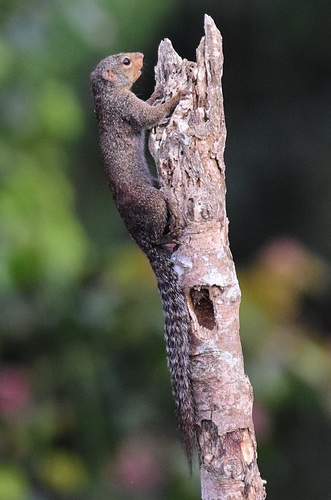
Small Sun Squirrel
Heliosciurus punctatus
A nimble acrobat of the West African canopy, the Small Sun Squirrel is known for its beautiful speckled coat and its charming habit of basking in the tropical morning sun.
Quick Identification
Size
Length: 30–40 cm (12–16 inches) including tail; Weight: 150–250 g (5.3–8.8 oz)
Colors
Speckled olive-brown or grayish upperparts; pale cream to yellowish belly; bushy tail with subtle dark and light banding
Key Features
- Speckled or 'punctuated' olive-brown coat
- Long, bushy tail with faint dark rings
- Pale, creamy-yellow underparts
- Small, rounded ears
- Smallest of the Heliosciurus genus
When You’ll See Them
Geographic range
Where Does the Small Sun Squirrel Live?
The Small Sun Squirrel is a native of the lush Upper Guinean forests of West Africa. Its core range is concentrated in Ivory Coast, Ghana, Liberia, and Sierra Leone, with occasional populations extending into neighboring Guinea. These squirrels are specialists of the lowland tropics, thriving in high-rainfall regions where the forest canopy remains dense and productive throughout the year.
Basemap © OpenStreetMap contributors
Behavior
The Small Sun Squirrel is a primarily arboreal rodent that spends the majority of its life in the forest canopy. True to its name, it is frequently seen 'sunning' itself on high branches during the early morning hours, spreading its limbs to soak up the heat before beginning its daily forage. Despite their sun-loving nature, they are quite shy and will quickly retreat into dense foliage if they detect movement or potential predators.
They are generally solitary or seen in pairs. While they are agile climbers, they are less known for the dramatic leaps associated with other squirrel species, preferring to run along branches rather than jump across wide gaps. They communicate through a series of high-pitched chirps and rhythmic tail-flicking, especially when defending their foraging territory or alerting others to the presence of raptors or snakes.
EverydayEarth exclusive
Camera Tips
To capture the Small Sun Squirrel on camera, you must focus on the vertical world rather than the ground. These squirrels rarely descend to the forest floor, so mounting your AI camera 2 to 4 meters (6 to 13 feet) high on a sturdy tree trunk is essential. Angle the camera slightly downward to view a horizontal branch or a 'junction' where several branches meet, as these are natural highways for the squirrels as they travel between feeding sites.
Baiting can be highly effective for this species if local regulations allow. A smear of fruit paste or peanut butter on the bark directly in front of the lens will encourage them to pause long enough for a clear identification shot. Since they are sun-seekers, try to position your camera on the eastern or southern side of a tree where the morning light hits the trunk; the 'sun-basking' behavior provides the best natural lighting for high-quality, high-contrast images.
Set your camera to a fast trigger speed and burst mode. Small Sun Squirrels are twitchy and fast-moving; a single photo might capture only a tail, but a three-shot burst significantly increases your chances of getting a full-body profile. High-resolution video (4K if available) is also recommended to capture their unique tail-flicking communication and foraging movements, which are key diagnostic behaviors.
Similar Species
Species that look similar or are commonly confused with Small Sun Squirrel.
Frequently Asked Questions
Record Small Sun Squirrel at your habitat
Connect a camera to start building your own species record — AI identifies every visitor automatically.