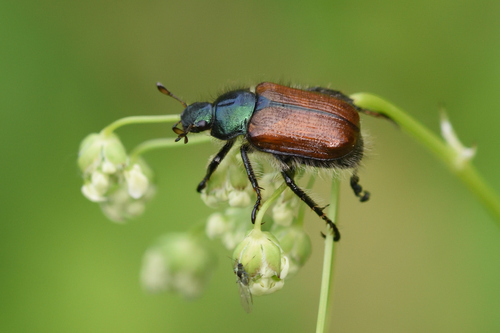
Garden Chafer
Phyllopertha horticola
Meet the 'June Bug' of the garden world, a fuzzy, metallic-green gem that brings life to backyard blossoms. Watch as these bumbling aviators emerge from the soil to herald the start of summer.
Quick Identification
Size
8.5–11 mm (0.33–0.43 inches) in length
Colors
Metallic blue-green or black head and thorax; reddish-brown or chestnut-colored elytra (wing cases); dark, hairy underside.
Key Features
- Shiny metallic green head and thorax contrast with brown wing cases
- Body covered in conspicuous fine greyish hairs
- Antennae end in a distinct three-pronged fan or club
- Compact, oval-shaped body typical of scarab beetles
When You’ll See Them
Behavior
Garden Chafers are highly active beetles best known for their sudden, high-density appearances in late spring and early summer. During their peak season, you might see dozens or even hundreds of them flying low over lawns or congregating on ornamental shrubs. Unlike many other beetles that prefer the cover of night, Garden Chafers are true sun-lovers, spending their daylight hours feeding on leaves and flowers or searching for mates in the warmth of the afternoon.
While the adults are busy above ground, the larvae (often called white grubs) live a very different life beneath the surface. They spend the winter months underground, feeding on the roots of grasses. This behavior often makes them a topic of conversation for gardeners, as large populations can cause yellow patches in lawns. However, they also serve as a vital food source for backyard birds like starlings and crows, who can be seen vigorously probing the soil to find them.
In terms of social interaction, these beetles aren't 'social' in a colonial sense like bees, but they are gregarious. They often gather in large numbers on 'host plants' like rose bushes or fruit trees. To humans, they are completely harmless—they don't bite or sting—though their clumsy flight patterns might occasionally lead to an accidental collision with a backyard observer.
EverydayEarth exclusive
Camera Tips
Capturing the Garden Chafer on camera requires a different strategy than photographing larger mammals or birds. Because these beetles are small and move relatively slowly when feeding, a macro lens or a camera with a high-quality 'close-up' mode is essential. Position your camera about 6 to 12 inches away from flowering plants that are currently in bloom, particularly roses or brambles, which act as natural magnets for these beetles. If you are using a trail camera, ensure it has a minimum focal distance that allows for clear images at close range, or use a clip-on macro lens accessory.
Placement is everything. Rather than pointing the camera at the ground, aim it at the sunny side of a shrub or a patch of tall grass at eye level. Garden Chafers are cold-blooded and rely on the sun to energize them for flight, so they will often bask on leaves before taking off. An angle that captures the side of the beetle will best showcase the beautiful contrast between their metallic green thorax and their fuzzy, chestnut-brown wing cases. If your camera allows for it, use a high shutter speed to freeze the motion of their wings, which beat incredibly fast during their buzzing low-altitude flights.
Timing your capture is also critical. Because Garden Chafers have a very short adult lifespan (often only a few weeks), you want to have your gear ready by mid-May. Set your camera to take 'burst' photos or short 10-second video clips. Video is particularly effective for this species because it captures their characteristic 'bumbling' flight and the way they clamber over petals. Since they are most active during the hottest part of the day, ensure your camera isn't in a spot where sun glare will wash out the metallic sheen of their shells.
If you want to capture the 'swarming' behavior over a lawn, set your camera on a low tripod or even directly on the ground, angled slightly upward. Use a time-lapse setting with an interval of one photo every 5-10 seconds during the late morning. When played back, this creates a fascinating visual record of the 'dance' these beetles perform as they emerge from the soil and search for mates. For the best results, look for areas where the grass is slightly thinning, as this is often where the highest concentration of emerging adults will be found.
Similar Species
Species that look similar or are commonly confused with Garden Chafer.
Frequently Asked Questions
Record Garden Chafer at your habitat
Connect a camera to start building your own species record — AI identifies every visitor automatically.