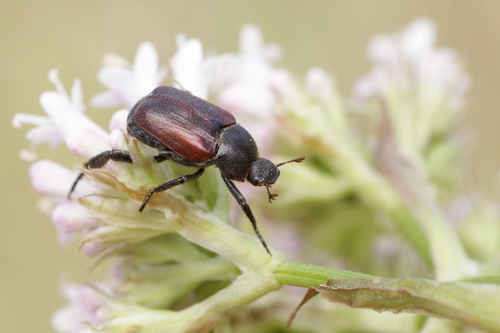
Welsh Chafer
Hoplia philanthus
A glittering jewel of the summer garden, the Welsh Chafer dazzles with its iridescent scales and sun-loving personality. Look for these metallic beetles dancing among your flowerbeds on the warmest days of June.
Quick Identification
Size
7–9 mm (0.27–0.35 inches) in length
Colors
Reddish-brown elytra (wing cases) often dusted with iridescent turquoise, silver, or gold scales; dark head and thorax; legs frequently have a silvery sheen.
Key Features
- Body covered in fine, metallic iridescent scales
- Thickened hind legs ending in a single large claw
- Reddish-brown wing cases visible beneath scales
- Compact, convex 'scarab' body shape
When You’ll See Them
Behavior
The Welsh Chafer is a charming, medium-sized beetle that brings a touch of iridescence to the garden during the early summer months. Despite its name, it is found across much of the UK and Northern Europe, particularly in areas with sandy or well-drained soils. These beetles are highly active during the day, especially when the sun is at its peak. You will often find them congregating on flower heads, where they clumsily scramble over petals in search of pollen and nectar.
Unlike many other beetles that prefer the cover of night, Welsh Chafers are sun-seekers. They are capable flyers and will move frequently between plants to find the best feeding spots. While they are social in the sense that many may feed on the same shrub, they do not have a complex social structure. They are harmless to humans and are a joy to observe as their scales catch the light, shifting between shades of green, blue, and gold depending on the angle.
EverydayEarth exclusive
Camera Tips
Capturing the Welsh Chafer requires a different strategy than larger wildlife. Because of their small size, a macro lens or a close-focusing bridge camera is highly recommended. If you are using an AI-powered backyard camera, position it within 12 inches of 'landing pad' flowers like Oxeye Daisies, Roses, or Brambles. These are their favorite feeding stations, and they will often stay on a single flower for several minutes, providing ample time for a clear shot.
Lighting is the most critical factor for this species. To capture their signature iridescence, ensure your camera is positioned to take advantage of direct sunlight. The metallic scales on their wing cases only 'glow' when the light hits them at certain angles. Try to set up your camera facing east or west during the mid-morning or mid-afternoon to catch the slanted light, which often highlights the texture of their scales better than the harsh overhead midday sun.
If your camera has a time-lapse feature, this is often more effective than motion-triggering for insects. Set the camera to take a photo every 30 seconds between 11 AM and 2 PM on a sunny day. This will likely catch the beetles as they land and depart. Additionally, avoid placing the camera in high-wind areas; Welsh Chafers are light and will fly away if the flowers are swaying too violently, and the movement may cause focus issues for your lens.
Similar Species
Species that look similar or are commonly confused with Welsh Chafer.
Frequently Asked Questions
Record Welsh Chafer at your habitat
Connect a camera to start building your own species record — AI identifies every visitor automatically.