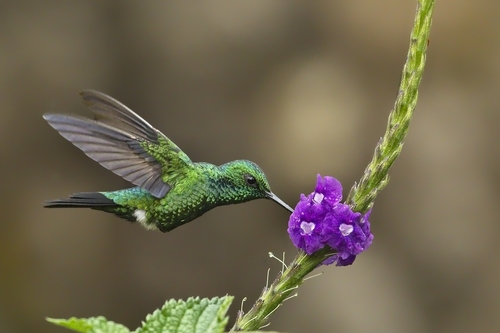
Garden Emerald
Chlorostilbon assimilis
A shimmering jewel of the Central American Pacific coast, the Garden Emerald is a tiny but feisty hummingbird that brings vibrant green color and high-energy antics to any backyard garden.
Quick Identification
Size
7.5–8.5 cm (3–3.3 in) in length; weighs approximately 3.1–3.8 g (0.11–0.13 oz)
Colors
Males are shimmering emerald green with a dark, blue-black forked tail. Females are metallic green above and pale greyish-white below, with a distinctive white stripe behind the eye.
Key Features
- Shimmering emerald green plumage (males)
- Deeply forked, dark blue-black tail
- Straight, all-black bill
- Distinctive white post-ocular stripe on females
- Small, compact build with rapid wingbeats
When You’ll See Them
Geographic range
Where Does the Garden Emerald Live?
The Garden Emerald is a specialist of the Pacific lowlands and foothills of Central America. Its native range is concentrated along the Pacific slope from southwestern Costa Rica through the entirety of Panama, including various offshore islands like the Pearl Islands. It is a year-round resident within this tropical corridor, flourishing wherever flowering plants and edge habitats are present.
Basemap © OpenStreetMap contributors
Behavior
The Garden Emerald is a spirited and highly active hummingbird, known for its bold personality despite its diminutive size. Often found darting between flowering shrubs, these birds are remarkably territorial. Males will aggressively defend prime nectar sources, using sharp, twittering calls and rapid aerial dives to chase away competitors, including hummingbirds much larger than themselves.
While they are frequent visitors to backyard feeders, they also utilize a foraging strategy known as 'trap-lining,' where they visit a specific circuit of flowering plants in a predictable order throughout the day. In residential areas, they have become well-adapted to human presence and are often seen hovering just inches away from porches or windows to investigate colorful objects.
EverydayEarth exclusive
Camera Tips
To capture the stunning iridescence of the Garden Emerald, camera placement is everything. Position your AI-powered camera within 2 to 3 feet of a red or tubular-shaped flower, such as Porterweed (Stachytarpheta) or Firebush (Hamelia patens). Ensure the camera is at eye level with the blossoms, approximately 3 to 5 feet off the ground, to catch the bird in a hovering position rather than just a top-down view of its back.
Lighting is the 'secret sauce' for hummingbird photography. Try to orient your camera so the sun is behind the lens or at a slight angle to the side. This allows the sunlight to hit the male's metallic green feathers directly, creating that brilliant 'glow' that defines the species. If the bird is in the shade, it may appear dark or almost black. Early morning light (between 7 and 9 AM) provides the softest, most flattering illumination without harsh shadows that can obscure the bird's features.
Since these birds move at lightning speeds, use the highest shutter speed or 'Action' mode available on your camera settings. If your device supports burst mode or high-frame-rate video, enable it to increase the chances of catching the wings in a graceful position rather than a blur. In your backyard, a hummingbird feeder filled with a simple 4:1 water-to-sugar ratio is the best lure, but placing the camera near a 'perching twig' a few feet away from the feeder can result in beautiful, candid shots of the bird resting between feeds.
Similar Species
Species that look similar or are commonly confused with Garden Emerald.
Blue-tailed Emerald
Very similar, but the Garden Emerald has a more deeply forked tail and is geographically separated, found mostly on the Pacific slope.
Snowy-bellied Hummingbird
Easily distinguished by its bright white lower belly and vent, whereas the Garden Emerald is almost entirely green below.
Frequently Asked Questions
Record Garden Emerald at your habitat
Connect a camera to start building your own species record — AI identifies every visitor automatically.