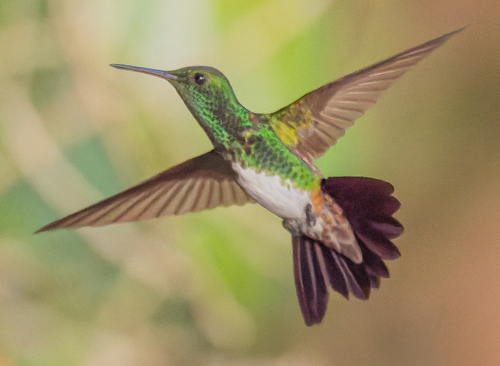
Snowy-bellied Hummingbird
Saucerottia edward
A shimmering emerald of the tropics, the Snowy-bellied Hummingbird is a garden favorite known for its brilliant white breast and spirited personality. Easily attracted to backyard feeders, this bold little bird is a perfect subject for your AI-powered nature camera.
Quick Identification
Size
Length: 10 cm (3.9 in) | Wingspan: 12-14 cm (4.7-5.5 in) | Weight: 4.5 g (0.16 oz)
Colors
Brilliant metallic green head, back, and throat; stark snowy-white belly and lower breast; coppery to purplish-bronze rump and tail; black upper mandible with pinkish-base on the lower mandible.
Key Features
- Crisp white belly contrasting sharply with emerald green throat
- Coppery-bronze or purplish rump and tail feathers
- Medium-sized, straight black bill
- Aggressive, territorial behavior around nectar sources
When You’ll See Them
Sightings on EverydayEarth
Apr 13, 2026
A bustling scene at the hummingbird feeder features a variety of species. A male White-necked Jacobin is particularly active, often hovering or perching to drink. Several Blue-chested and Snowy-bellied Hummingbirds flit in and out, competing for space. A Long-billed Hermit makes a quick appearance, using its long curved beak to feed briefly before flying off.
Apr 13, 2026
A busy scene at the nectar feeder as several hummingbirds gather to drink. The birds are seen perched along the rim of the red feeder tray, while others hover nearby, waiting for an opening or darting in to compete for a feeding port.
Apr 12, 2026
A bustling scene at the feeder with multiple hummingbirds interacting. A White-necked Jacobin frequently hovers and darts around the center, while several Blue-chested and Snowy-bellied hummingbirds compete for positions at the feeding ports. The birds are highly active, constantly displacing each other and hovering in the humid afternoon air.
Apr 12, 2026
A busy afternoon at the nectar feeder in Soberania National Park. Several hummingbirds, including multiple White-necked Jacobins and a Blue-chested Hummingbird, compete for space and feed. Numerous large ants are also seen crawling across the red plastic tray of the feeder.
Apr 12, 2026
A busy scene at the hummingbird feeder features several species interacting. Multiple green-plumaged hummingbirds, including Blue-chested and Snowy-bellied Hummingbirds, are perched and drinking. A male White-necked Jacobin with a striking blue head and white belly flies in from the right to join the group, momentarily causing some of the smaller birds to flutter and adjust their positions.
Apr 12, 2026
A Blue-chested Hummingbird is perched on the upper rim of the feeder, looking around the forest clearing. Moments later, a Snowy-bellied Hummingbird arrives and lands on the lower feeding tray. Both hummingbirds remain at the feeder for several seconds before the Blue-chested Hummingbird flies off, followed immediately by the Snowy-bellied Hummingbird.
Behavior
The Snowy-bellied Hummingbird is a feisty and conspicuous resident of the Central American tropics. Known for its territorial nature, it often claims a specific patch of flowers or a garden feeder as its own, vigorously chasing away larger hummingbird species. Despite its small size, it is incredibly bold and can be seen darting through gardens with a distinctive, direct flight path.
These birds are highly adaptable and have benefited from human landscaping, often moving into suburban backyards where nectar-rich flowers are abundant. While they are generally solitary like most hummingbirds, they are quite vocal, frequently emitting a series of high-pitched chirps and buzzy notes while perched or during aerial displays to warn off intruders.
EverydayEarth exclusive
Camera Tips
To capture high-quality images of the Snowy-bellied Hummingbird, camera placement is everything. Since these birds are highly territorial, identify a 'sentinel perch'—usually a bare twig or a high wire near a food source where the bird sits to survey its kingdom. Aim your AI camera at this perch with a clean, distant background to ensure the bird is in sharp focus while the foliage remains a soft blur. For height, 1.5 to 2 meters (5 to 6 feet) is ideal, as this mimics their preferred foraging and perching level.
Lighting is the biggest challenge when photographing hummingbirds. To make their metallic emerald feathers 'pop,' position your camera so the sun is behind you or at a 45-degree angle to the side. This allows the light to hit the microscopic structures in their feathers, revealing the brilliant iridescence that can otherwise look dark or dull in the shade. If you are using a trigger-based trail camera, set it to 'Burst Mode' or 'Photo + Video.' Hummingbirds move so fast that a single shot often catches only a wing-tip; a 3-5 shot burst significantly increases your chances of getting a perfectly centered frame.
If you want to lure them specifically to your lens, plant 'Porterweed' (Stachytarpheta) or 'Firebush' (Hamelia patens) directly in front of your camera's field of view. These are irresistible magnets for the Snowy-bellied. Avoid using fast-moving feeders as your primary focal point if your camera has a slow shutter speed, as this results in motion blur. Instead, focus on the flowers where the bird must pause for a split second to hover and drink. Early morning light provides the best color saturation and the most active bird behavior.
Similar Species
Species that look similar or are commonly confused with Snowy-bellied Hummingbird.
Rufous-tailed Hummingbird
Lacks the white belly and features a bright reddish-brown (rufous) tail and a pinker bill.
Blue-chested Hummingbird
Lacks the pure white belly; males have a glittering blue patch on the upper breast.
Charming Hummingbird
Very similar but found in different ranges (Pacific slope of CR/Panama) and has a more spotted throat and less uniform white on the belly.
Frequently Asked Questions
Record Snowy-bellied Hummingbird at your habitat
Connect a camera to start building your own species record — AI identifies every visitor automatically.