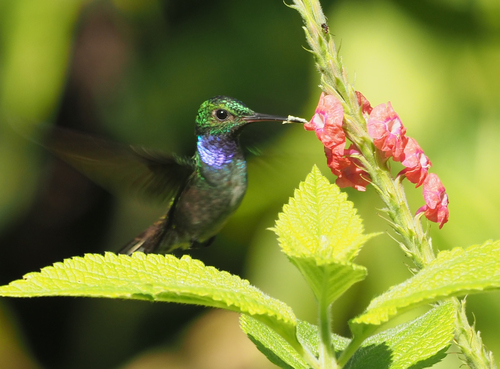
Blue-chested Hummingbird
Polyerata amabilis
A glittering jewel of the tropical lowlands, the Blue-chested Hummingbird dazzles with its namesake violet-blue breast and emerald crown. A master of the forest edge, this resident of Central and South America is a favorite for backyard observers in the tropics.
Quick Identification
Size
8.5-9 cm (3.3-3.5 inches) long; wingspan approx. 11 cm (4.3 inches); weight 3.2-4.5 grams
Colors
Males feature a glittering green crown and a brilliant violet-blue chest patch; females have greyish-white underparts with green spotting on the throat and sides.
Key Features
- Male's iridescent violet-blue breast patch
- Glittering emerald green crown
- Straight black bill with a pinkish base on the lower mandible
- Bronze-green upperparts and tail
When You’ll See Them
Sightings on EverydayEarth
Apr 1, 2026
A high-energy scene at the nectar station with at least seven hummingbirds visible. Male White-necked Jacobins and Blue-chested Hummingbirds are actively feeding, hovering, and jockeying for position around the red feeder tray in the late afternoon light.
Apr 13, 2026
A lively scene unfolds at the nectar feeder as multiple hummingbirds compete for a spot. A White-necked Jacobin perches prominently, displaying its striking blue head and white tail while feeding. A Long-billed Hermit briefly appears on the left with its characteristic curved beak, while a Blue-chested Hummingbird darts in and out of the frame. Several small insects are also seen buzzing around the feeder ports.
Apr 13, 2026
A single hummingbird darts into the frame, briefly landing on the perch of the red nectar feeder. It remains for only a second, looking around before quickly flying back into the surrounding rainforest canopy.
Apr 13, 2026
A White-necked Jacobin is perched on the right side of the red feeder, calmly drinking nectar. A Blue-chested Hummingbird briefly appears on the left, hovering near the feeding ports for a few seconds before darting out of view. The Jacobin continues to feed and look around for the remainder of the clip.
Apr 13, 2026
A bustling scene at the hummingbird feeder features a variety of species. A male White-necked Jacobin is particularly active, often hovering or perching to drink. Several Blue-chested and Snowy-bellied Hummingbirds flit in and out, competing for space. A Long-billed Hermit makes a quick appearance, using its long curved beak to feed briefly before flying off.
Apr 13, 2026
A White-necked Jacobin and a Blue-chested Hummingbird are perched at the red nectar feeder. A second Blue-chested Hummingbird arrives from the right, fluttering around the feeder to compete for a spot. The Jacobin eventually takes flight, leaving the two smaller hummingbirds to feed in the lush, green tropical environment.
Geographic range
Where Does the Blue-chested Hummingbird Live?
This stunning hummingbird is native to the humid tropical lowlands of Central America and northwestern South America. Its core range spans from the Caribbean slopes of Nicaragua through Costa Rica and Panama, extending into the Pacific lowlands of Colombia and northwestern Ecuador. It is a non-migratory resident, staying within these lush, warm environments throughout the year.
Basemap © OpenStreetMap contributors
Behavior
The Blue-chested Hummingbird is a classic 'trap-liner,' a foraging strategy where the bird follows a consistent, daily route between widely dispersed nectar sources rather than defending a single flower patch. They are active and nimble, often seen darting through the understory and mid-canopy of forest edges. While they are not the most dominant hummingbird species, they are persistent and will return to the same flowers at regular intervals throughout the day.
During the breeding season, males may congregate in small, loose groups known as leks. Here, they perch on low branches and emit a series of thin, squeaky chirps to attract females. Unlike many other hummingbirds that perform dramatic aerial dives, the Blue-chested Hummingbird relies more on its shimmering plumage and consistent vocalizations to find a mate. They are generally tolerant of human presence, often visiting gardens and plantations that provide sufficient cover and floral variety.
EverydayEarth exclusive
Camera Tips
To capture high-quality footage of a Blue-chested Hummingbird, focus your camera on 'trap-line' plants like Heliconia or Porterweed. These birds are creatures of habit; if you record them once, they will likely return to that same blossom every 30 to 60 minutes. Position your camera at a height of 3 to 5 feet, slightly angled toward the sun to ensure the light hits the male's iridescent blue chest patch, which only glows when viewed from specific angles.
Use a high shutter speed or a camera with a high-frame-rate 'Bird Mode' to avoid motion blur. Because these hummingbirds often hover for only a few seconds before darting to the next flower, setting a narrow detection zone on your AI camera will prevent 'false triggers' from moving leaves while ensuring you catch the bird the moment it enters the frame.
For the best results, look for a 'resting twig' near a nectar source. Blue-chested Hummingbirds often perch on thin, bare branches for several minutes to preen or keep watch. A camera placed 4-6 feet away from such a perch can provide much more detailed, still images of their plumage and bill structure than a camera at a feeder alone. Early morning light is your best friend, as it brings out the deep bronze tones in their wings.
Similar Species
Species that look similar or are commonly confused with Blue-chested Hummingbird.
Charming Hummingbird
Very similar but found on the South Pacific slope of Costa Rica and Panama; the blue patch on the male is typically more extensive.
White-vented Plumeleteer
Larger with conspicuous white under-tail coverts and bright pink legs, lacking the specific blue chest patch of the Blue-chested.
Violet-bellied Hummingbird
The male has a violet-blue belly and throat rather than just a chest patch, and the tail is more deeply forked.
Frequently Asked Questions
Record Blue-chested Hummingbird at your habitat
Connect a camera to start building your own species record — AI identifies every visitor automatically.