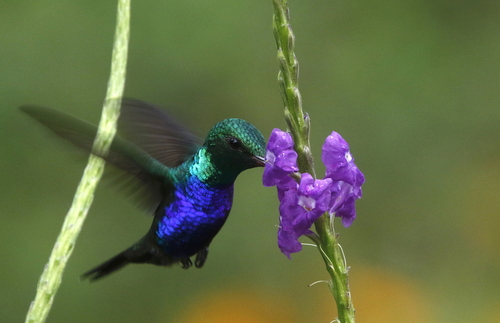
Violet-bellied Hummingbird
Chlorestes julie
A jewel of the understory, the male Violet-bellied Hummingbird dazzles with its namesake iridescent plumage. Found in the humid forests of Central and South America, this tiny flyer is a master of low-level foraging.
Quick Identification
Size
Length 3.2–3.5 in (8.1–8.9 cm); Wingspan approx 4.3 in (11 cm); Weight 0.11–0.12 oz (3.1–3.5 g)
Colors
Males have a metallic green head and throat with a brilliant, shimmering violet-blue belly. Females are bronzy-green above with pale greyish-white underparts.
Key Features
- Shimmering violet-blue belly (males only)
- Straight bill with a distinctive pinkish-orange lower mandible
- Metallic green throat and crown
- Understory specialist often seen at lower heights
When You’ll See Them
Geographic range
Where Does the Violet-bellied Hummingbird Live?
Native to the lush tropical landscapes of Central and South America, the Violet-bellied Hummingbird flourishes from central Panama through the humid lowlands of Colombia, western Ecuador, and into far northwestern Peru. This species is a true specialist of the Neotropical humid zones, where it thrives in the transitions between dense forest and more open, shrubby habitats near water sources.
Basemap © OpenStreetMap contributors
Behavior
The Violet-bellied Hummingbird is an energetic and somewhat elusive inhabitant of the forest understory. Unlike many hummingbirds that prefer the sun-drenched canopy, this species is frequently found darting through low-level vegetation and shaded shrubbery. They are known for their 'trap-lining' feeding strategy, where they follow a consistent daily route to visit specific flowering plants in a set order, rather than aggressively defending a single territory.
In social settings, they can be quite bold when interacting with other small hummingbirds but often defer to larger, more dominant species at crowded nectar sources. They are primarily solitary except during the breeding season. For backyard observers, they are often the 'early birds,' appearing at feeders or flowers just as the sun begins to rise and returning for a final drink as dusk settles.
EverydayEarth exclusive
Camera Tips
To capture the stunning iridescent violet of this hummingbird, camera placement is everything. Position your AI-powered camera at a height of about 3 to 5 feet, targeting low-hanging nectar-rich flowers like Heliconias or porterweed (Stachytarpheta). Because these birds are understory specialists, they rarely venture high into the canopy, so keeping your gear at eye level or slightly lower will yield the most intimate shots and better trigger rates.
Lighting is the biggest challenge when photographing the Violet-bellied Hummingbird. Their signature violet belly only 'pops' when light hits it at a specific angle; otherwise, it can look dark or black. Try to orient your camera so the sun is behind or slightly to the side of the lens during the early morning hours. Using a camera with a fast shutter speed or a high-frame-rate video mode is essential to freeze their rapid wingbeats and capture the shimmer without motion blur.
If you are using a feeder to attract them, choose a shaded spot near dense shrubbery where they feel safe. They are more likely to visit feeders that provide some cover nearby rather than those placed in wide-open lawns. Set your trigger sensitivity to high, as these small birds move exceptionally fast and can enter and exit the frame in a split second. A pre-roll or 'burst' photo setting is highly recommended to catch the moment they hover before the flower.
Similar Species
Species that look similar or are commonly confused with Violet-bellied Hummingbird.
Sapphire-throated Hummingbird
Features a brilliant blue throat and green belly, whereas the Violet-bellied Hummingbird has a green throat and violet belly.
Blue-chested Hummingbird
Has a blue patch concentrated on the chest rather than the belly, and the female has more distinct spotting on the throat.
Frequently Asked Questions
Record Violet-bellied Hummingbird at your habitat
Connect a camera to start building your own species record — AI identifies every visitor automatically.