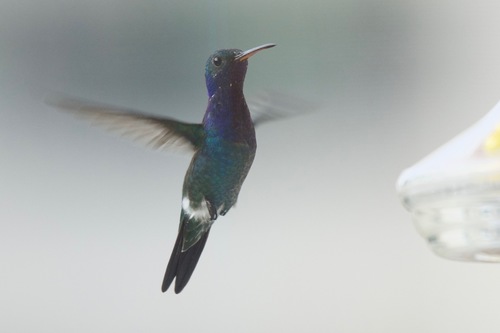
Sapphire-throated Hummingbird
Chrysuronia coeruleogularis
With a throat like a polished gemstone and a spirit that refuses to back down, the Sapphire-throated Hummingbird is a jewel of the Central American lowlands. Discover how to bring this shimmering visitor into focus with your backyard camera.
Quick Identification
Size
8.5–9.5 cm (3.3–3.7 in) in length; Weight approx 4–4.5 g (0.14–0.16 oz)
Colors
Males feature metallic green upperparts with a brilliant violet-blue throat and chest; females are primarily metallic green above with white underparts and green spots on the flanks.
Key Features
- Brilliant violet-blue throat and upper breast in males
- Deeply forked, dark blue-black tail
- Straight, medium-length all-black bill
- Glittering metallic green crown and back
When You’ll See Them
Behavior
The Sapphire-throated Hummingbird is a high-energy dynamo, often seen darting with precision between nectar sources. While they can be solitary, they are fiercely territorial over "their" patches of flowers or feeders, frequently engaging in mid-air aerial dogfights and vocal chipping to defend their foraging grounds from rivals.
In backyard settings, they are curious but cautious. They tend to follow a regular "trap-line" foraging route, visiting the same flowers at predictable intervals throughout the day. Unlike some bolder species, they may retreat to nearby thickets if there is too much human movement, but they quickly return to their routine once the environment is quiet.
EverydayEarth exclusive
Camera Tips
To capture the stunning iridescent blue of the male Sapphire-throated Hummingbird, camera placement is everything. Position your AI-powered camera 3 to 5 feet away from a nectar feeder or a cluster of favored flowers like Porterweed or Hibiscus. Angle the lens slightly downward to catch the light reflecting off their metallic feathers; side-lighting during the "golden hours" of early morning or late afternoon will yield the most vibrant colors without blowing out the highlights on their metallic green backs.
Since these birds move at incredible speeds, use a high shutter speed setting if your camera allows for manual overrides, or select a "Sports" or "Fast Motion" mode. A high frame rate is essential to catch the moment they hover; otherwise, you may end up with a green blur. Because they are habitual, once you spot one on your live feed, keep your camera in that location, as they are highly likely to return to the exact same perch or bloom within the hour.
Consider the background to make the bird's colors pop. A dark, out-of-focus foliage background helps the shimmering green and sapphire tones stand out. If you are using a trail camera, ensure the PIR sensor is set to high sensitivity, as the small body mass of a hummingbird can sometimes fail to trigger sensors designed for larger mammals. A pro tip is to place a small, bare "perching twig" about two feet from a feeder—they love to rest and survey their territory between feeds, giving you a perfectly still subject for a high-resolution portrait.
Similar Species
Species that look similar or are commonly confused with Sapphire-throated Hummingbird.
Blue-throated Goldentail
The Goldentail has a bright reddish bill with a black tip and a distinct copper-gold tail, unlike the all-black bill and dark tail of the Sapphire-throated.
Blue-chested Hummingbird
The blue on the chest is usually lighter and more azure, and its tail is notched rather than deeply forked.
Frequently Asked Questions
Record Sapphire-throated Hummingbird at your habitat
Connect a camera to start building your own species record — AI identifies every visitor automatically.