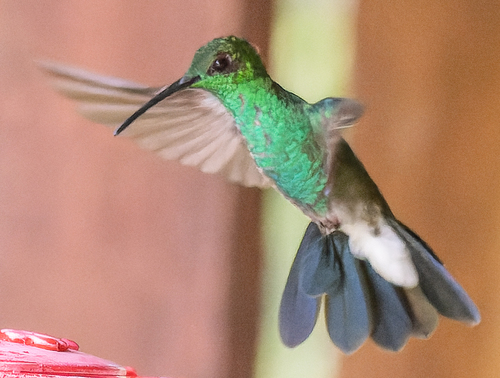
White-vented Plumeleteer
Chalybura buffonii
Meet the 'emerald with the white trousers.' The White-vented Plumeleteer is a large, charismatic hummingbird known for its bold personality and striking, fluffy white undertail feathers.
Quick Identification
Size
Length: 10.5-12 cm (4.1-4.7 in); Weight: 6-8 g (0.21-0.28 oz)
Colors
Iridescent bronze-green upperparts; males have brilliant blue-green underparts, while females are light grey below. Both feature striking white undertail coverts and pinkish-red legs.
Key Features
- Large, puffy white undertail coverts (the 'vent')
- Bright pink or reddish legs and feet
- Relatively large, heavy-bodied hummingbird profile
- Slightly decurved black bill
When You’ll See Them
Behavior
The White-vented Plumeleteer is a bold and spirited hummingbird, often acting as the 'boss' of the garden. Unlike many smaller, more timid species, the Plumeleteer is highly territorial and will aggressively defend a cluster of flowers or a feeder from intruders. You will often see them perched on a prominent high twig between feeding bouts, surveying their kingdom for rivals.
Their flight is distinctive—powerful and direct with a deep, audible hum. When they hover to feed, they often pump their tails, showing off the fluffy white feathers underneath. While they are solitary like most hummingbirds, they are quite comfortable around human habitation and can become regular, reliable visitors to backyard spaces that provide consistent food sources.
EverydayEarth exclusive
Camera Tips
To capture high-quality footage of a White-vented Plumeleteer, you need to focus on their predictable feeding patterns. Position your AI-powered camera approximately 3 to 4 feet away from a 'nectar hub'—either a hummingbird feeder or a stand of tubular flowers like Heliconia, Hibiscus, or Porterweed. Because these birds are slightly larger than most common emeralds, they have a larger 'presence' on screen, so ensure your camera is mounted at eye-level with the flowers (roughly 4 to 5 feet high) to capture the iridescent shimmer of their chest feathers.
Lighting is your best friend when filming hummingbirds. Place your camera with the sun at its back, especially during the 'golden hours' of early morning or late afternoon. This 'front-lighting' hits the microscopic structure of their feathers, turning dull greens into brilliant, glowing emeralds and teals. If your camera allows for manual settings, a higher frame rate (60fps or higher) is ideal to reduce motion blur from their incredibly fast wing beats, though the Plumeleteer’s habit of hovering steadily makes them an easier target than more erratic species.
Since Plumeleteers are territorial, they often use a specific 'sentinel perch' nearby. If you notice a bird returning to the same bare twig repeatedly, move a second camera to focus on that branch. This is where you will capture more intimate behaviors like preening, stretching, and guarding. Avoid using red-dyed nectar in feeders; instead, use a clear 4:1 water-to-sugar ratio, as the birds are naturally attracted to the red color of the feeder itself or the surrounding flowers.
Similar Species
Species that look similar or are commonly confused with White-vented Plumeleteer.
Frequently Asked Questions
Record White-vented Plumeleteer at your habitat
Connect a camera to start building your own species record — AI identifies every visitor automatically.