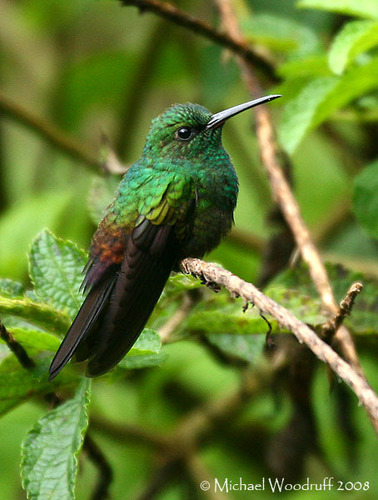
Bronze-tailed Plumeleteer
Chalybura urochrysia
Meet the 'pink-booted' gem of the jungle. The Bronze-tailed Plumeleteer is a feisty, emerald-green hummingbird famous for its dark bronze tail and surprisingly bright pink feet.
Quick Identification
Size
Length: 10.5-12 cm (4.1-4.7 in); Weight: 6-8 g (0.21-0.28 oz)
Colors
Shimmering emerald green body, dark bronzy-purple or blackish tail, and bright pinkish-red legs and feet.
Key Features
- Bright pinkish-red legs and feet
- Deep bronze to purplish-black tail
- Solid iridescent green underparts in males
- Relatively large, robust hummingbird build
When You’ll See Them
Geographic range
Where Does the Bronze-tailed Plumeleteer Live?
This stunning hummingbird is native to the humid tropical regions of Central and South America. Its core range stretches from the Caribbean slopes of eastern Nicaragua through Costa Rica and Panama, extending into the Chocó region of western Colombia and northwestern Ecuador. It is a lowland specialist that thrives in high-rainfall environments where flowering plants are available throughout the year.
Basemap © OpenStreetMap contributors
Behavior
The Bronze-tailed Plumeleteer is a bold and highly territorial hummingbird known for its aggressive defense of nectar sources. It often dominates smaller species at feeders and flowering trees, using its relatively large size to chase away intruders. Unlike some shy forest species, the Plumeleteer is quite vocal, frequently giving a high-pitched, metallic 'tsip' call while foraging or perched.
These birds spend much of their time in the mid-canopy or forest edges, but they are common visitors to backyard gardens that offer the right floral resources. They have a characteristic habit of perching on open, horizontal twigs between feeding sessions, which makes them excellent subjects for stationary cameras. Their flight is powerful and direct, and they are often the first hummingbirds to arrive at a patch of flowers at dawn.
EverydayEarth exclusive
Camera Tips
To capture the Bronze-tailed Plumeleteer on camera, placement is the most critical factor. Because these birds are highly territorial, they often use the same 'lookout' perches near a food source. Position your camera 4 to 5 feet off the ground, focused on a slender horizontal branch near a nectar feeder or a patch of Heliconia. If your camera has a 'macro' or 'close-focus' setting, use it—this bird's most unique feature is its bright pink feet, which are only visible from a few feet away.
Lighting is essential to showcase their iridescence. Try to orient your camera so that the sun is behind the lens during the peak morning hours (6-9 AM). This allows the light to bounce off the bird’s metallic green chest and dark bronze tail, preventing the bird from appearing as a simple black silhouette. If you are using a motion-triggered camera, set the sensitivity to high and the trigger interval to the shortest possible delay, as hummingbirds move incredibly fast.
Since this species thrives in humid, rainy environments, ensure your camera housing is clean and use a small rain shield or 'roof' to keep droplets off the lens. A blurry, wet lens will fail to trigger the AI recognition. If you are using a backyard feeder to attract them, choose one with a perch; the Bronze-tailed Plumeleteer is a relatively heavy hummingbird and prefers to sit while drinking, providing a much longer window for a high-quality capture.
Similar Species
Species that look similar or are commonly confused with Bronze-tailed Plumeleteer.
Frequently Asked Questions
Record Bronze-tailed Plumeleteer at your habitat
Connect a camera to start building your own species record — AI identifies every visitor automatically.