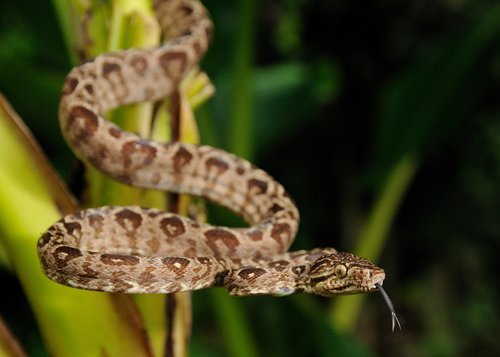
Garden Tree Boa
Corallus hortulana
The Garden Tree Boa is nature's most colorful canopy dweller, exhibiting a range of vibrant hues from sunset orange to mossy grey. A nocturnal specialist, this slender snake uses advanced heat-sensing pits to navigate and hunt in the dark South American forests.
Quick Identification
Size
1.5 to 2.0 meters (5 to 6.5 feet) in length; 0.5 to 1.5 kg (1.1 to 3.3 lbs)
Colors
Highly polymorphic; can be solid or patterned in shades of grey, brown, olive, bright yellow, orange, or brick red.
Key Features
- Extremely slender body with a large, bulbous head distinct from the neck
- Deep heat-sensing pits along the upper and lower labial scales
- Highly variable coloration and patterning
- Large, prominent eyes with vertical pupils
When You’ll See Them
Geographic range
Where Does the Garden Tree Boa Live?
This stunning snake is native to the tropical reaches of South America, where it thrives across the vast Amazon Basin and the Guiana Shield. Its primary range covers Brazil, Colombia, Peru, Ecuador, Venezuela, Guyana, Suriname, and French Guiana. While it is a specialist of the deep jungle, it has successfully adapted to human-altered landscapes, making it a frequent visitor to riverside orchards and residential gardens that offer sufficient vertical cover.
Basemap © OpenStreetMap contributors
Behavior
The Garden Tree Boa is a master of the vertical world, spending the vast majority of its life high above the ground. Primarily nocturnal, these snakes spend their daylight hours coiled tightly in the safety of tree hollows, dense bromeliads, or thick vine tangles. As night falls, they become active hunters, moving with surprising agility through the canopy using their strong prehensile tails as an anchor.
While they are non-venomous, they are known for their feisty temperament. When threatened, they often form a tight defensive ball or strike repeatedly with an impressive reach. In a garden or backyard setting, they are generally shy and will avoid human interaction, though they are highly valued by locals for their ability to naturally control rodent and bat populations.
EverydayEarth exclusive
Camera Tips
Capturing the Garden Tree Boa on camera requires a shift in perspective—literally. Because these snakes are strictly arboreal, a ground-mounted trail camera is unlikely to ever see one. Mount your camera 5 to 10 feet up in a tree, focusing on horizontal branches or 'bridges' that connect different parts of the canopy. Areas near flowering trees that attract bats or nesting birds are prime locations for an ambush-hunting boa.
Since these snakes are active in total darkness, high-quality infrared (IR) capability is a must. Use 'No-Glow' IR flash settings if possible, as these snakes have sensitive heat-detecting pits and may be startled by or investigate the faint red glow of standard IR. Because they often remain motionless for hours while waiting for prey, use a high-sensitivity trigger or time-lapse mode to ensure you catch them during their slow, methodical movements between hunting perches.
For the best results, set your camera to video mode. Watching a Garden Tree Boa navigate the thin branches of a backyard tree using its prehensile tail is far more rewarding than a static image. Look for 'S-curve' body patterns in your footage, which indicate the snake is in a hunting posture. Avoid using artificial baits; instead, focus on providing a diverse garden habitat that attracts the small mammals and birds the boa naturally pursues.
Similar Species
Species that look similar or are commonly confused with Garden Tree Boa.
Frequently Asked Questions
Record Garden Tree Boa at your habitat
Connect a camera to start building your own species record — AI identifies every visitor automatically.