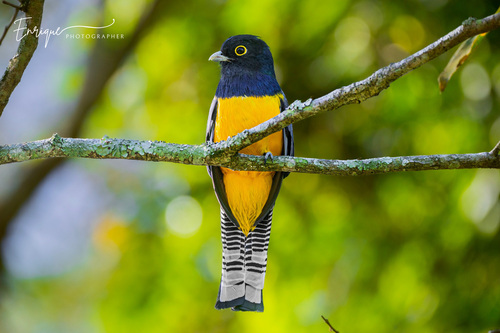
Gartered Violaceous Trogon
Trogon caligatus
A flash of violet and gold in the tropical canopy, the Gartered Violaceous Trogon is a master of the 'sit-and-wait' hunt. Discover how to identify this striking bird and capture its quiet beauty on your trail camera.
Quick Identification
Size
Length: 23–25 cm (9–10 in); Weight: 38–57 g (1.3–2.0 oz)
Colors
Males feature a violet-blue head and breast, green back, and a bright yellow belly. They have a yellow eye-ring and fine black-and-white barring on the tail's underside. Females are slate gray where the male is violet-blue.
Key Features
- Distinct yellow eye-ring
- Bright yellow belly contrasting with dark upperparts
- Fine black-and-white horizontal barring on the underside of the tail
- Stocky build with a relatively short, broad bill
When You’ll See Them
Geographic range
Where Does the Gartered Violaceous Trogon Live?
This stunning species is native to the Americas, with a range that begins in the coastal lowlands of eastern and southern Mexico. It is found throughout all of Central America and extends deep into northern South America, including Colombia, Venezuela, Ecuador, and Peru. It thrives primarily in tropical and subtropical regions where dense canopy and nesting sites are available.
Basemap © OpenStreetMap contributors
Behavior
The Gartered Violaceous Trogon is characterized by its "sit-and-wait" predatory style. It spends long periods perched perfectly still on mid-canopy branches, scanning the surrounding foliage for movement. Despite their vibrant colors, they can be remarkably difficult to spot until they suddenly launch into the air to snatch an insect or pluck a berry. Their flight is typically short and undulating, punctuated by a characteristic flick of the tail upon landing.
Socially, these birds are usually found alone or in pairs. They are famous for their unique nesting habits; they use their bills to excavate tunnels into active arboreal termite mounds or rotting wood. This symbiotic-like relationship with termites provides the trogon chicks with a regulated temperature and a level of protection from predators. While they are not overly shy, they tend to stay in the shadows of the canopy rather than in open sunlight.
EverydayEarth exclusive
Camera Tips
To successfully capture a Gartered Violaceous Trogon on camera, you need to think vertically. These birds rarely touch the ground, so avoid low-level trail cam setups. Instead, mount your camera between 6 and 12 feet high on a tree trunk, angled toward a known fruiting tree or a horizontal branch that serves as a regular lookout. Look for native trees like wild figs or laurels, which are their favorite grocery stores.
Because trogons can remain motionless for several minutes at a time, standard motion sensors might miss them or stop recording while the bird is still present. We recommend using a camera with a high-sensitivity PIR sensor or setting a "Time Lapse" mode to snap a photo every 60 seconds during the first three hours after sunrise. This ensures you catch the bird during its most active foraging window even if it isn't moving enough to trigger the video.
Lighting is often a challenge in the shaded tropical canopy where these birds live. Use a camera with a high-quality CMOS sensor capable of handling low-light conditions to ensure the violet and yellow plumage doesn't look washed out or grainy. If your camera allows for it, a faster shutter speed is beneficial; while the bird sits still, its "sallying" flight to grab fruit is incredibly fast and can result in a blur on slower cameras.
Finally, consider the audio. These trogons have a very distinct, repetitive calling pattern (a series of soft 'cow' notes). Using a camera that records high-quality audio can help you identify their presence even if they are just out of the frame, allowing you to adjust your placement for the following day. Placing a solar-powered water dripper nearby can also be a significant draw in drier tropical months, as the sound of moving water often attracts them from the canopy.
Similar Species
Species that look similar or are commonly confused with Gartered Violaceous Trogon.
Frequently Asked Questions
Record Gartered Violaceous Trogon at your habitat
Connect a camera to start building your own species record — AI identifies every visitor automatically.