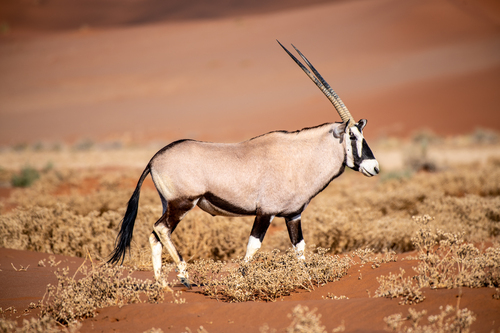
Gemsbok
Oryx gazella
The Gemsbok is the crown jewel of the desert, a masterpiece of evolution designed to thrive in the world's most punishing environments. With its iconic straight horns and striking facial mask, it stands as a symbol of endurance across the sands of Southern Africa.
Quick Identification
Size
Shoulder height: 1.2m (4ft); Length: 1.9-2.4m (6-8ft); Weight: 180-240kg (400-530lb)
Colors
Fawn-gray body with black and white facial markings; black stripes on the throat, flanks, and legs; white 'socks' on all four legs
Key Features
- Extremely long, straight, rapier-like horns (up to 120cm)
- Distinctive black-and-white 'mask' on the face
- Black stripe running horizontally along the lower flank
- Long, black horse-like tail
When You’ll See Them
Geographic range
Where Does the Gemsbok Live?
The Gemsbok is native to the vast, arid landscapes of Southern Africa, with its stronghold centered in the Kalahari and Namib Deserts. Its native range encompasses much of Namibia and Botswana, extending into parts of South Africa and western Zimbabwe. Interestingly, a thriving introduced population also exists in the United States, specifically within the White Sands region of New Mexico, where they have adapted perfectly to the American high desert.
Basemap © OpenStreetMap contributors
Recorded on EverydayEarth
Behavior
These antelopes are known for their defensive prowess; when cornered by predators like lions or hyenas, they use their sharp, spear-like horns to lethal effect. They are mostly nomadic, moving across vast distances to follow the sporadic rainfall that triggers the growth of fresh grasses. While generally shy, they are observant and will often stand perfectly still to watch a potential threat from a distance before galloping away at high speed.
EverydayEarth exclusive
Camera Tips
Capturing a Gemsbok on a trail camera requires a strategy focused on their movement patterns between foraging and resting areas. Because they are nomadic, placing cameras near rare water holes or established mineral licks is the most reliable way to ensure a sighting. In the absence of water, look for 'highways' through the sand—wide, well-trodden paths that cut through the scrub—and position your camera to catch a side-profile view of their striking markings.
Mount your camera higher than you would for smaller deer; about 1.2 to 1.5 meters (4 to 5 feet) is ideal. Gemsbok have very long horns, and a camera mounted too low or tilted poorly will often cut off the top of their most impressive feature. To get that perfect 'National Geographic' shot, try to face the camera North or South to avoid the harsh, direct African sun that can wash out the colors of their coat during the day.
These animals are active around the clock to avoid the midday heat, so high-quality night vision is a must. Because their eyes are highly reflective, a side-on angle of 45 degrees to the trail will help prevent 'white-eye' in your photos and videos. If you are tracking the introduced population in New Mexico, focus on the winter months when they congregate in larger groups to graze on the open plains, providing more frequent triggers for your AI camera.
Similar Species
Species that look similar or are commonly confused with Gemsbok.
Frequently Asked Questions
Record Gemsbok at your habitat
Connect a camera to start building your own species record — AI identifies every visitor automatically.