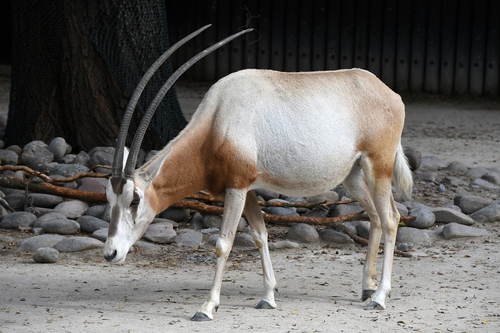
Scimitar-horned Oryx
Oryx dammah
Once declared extinct in the wild, the Scimitar-horned Oryx is making a miraculous comeback. Known for its elegant, sweeping horns and incredible desert endurance, this 'white ghost of the Sahara' is a testament to the power of modern conservation.
Quick Identification
Size
Body length of 1.5–2.4 m (4.9–7.9 ft); Weight of 100–210 kg (220–460 lb); Horns can reach 1.0–1.2 m (3.3–3.9 ft)
Colors
Primarily creamy white coat with a distinct reddish-brown (rufous) chest and neck; faint dark markings on the forehead and nose; males and females look nearly identical.
Key Features
- Long, backwards-curving horns shaped like a scimitar sword
- Pure white body with a contrasting rusty-red neck and chest
- Large, splayed hooves designed for walking on soft desert sand
- Square-shaped muzzle adapted for grazing short grasses
When You’ll See Them
Behavior
The Scimitar-horned Oryx is a master of desert survival, known for its ability to endure extreme heat that would be fatal to most other mammals. They are highly social animals, historically forming herds of dozens or even hundreds of individuals. In their current reintroduced habitats, they move in smaller groups, led by a dominant male. Their social structure is fluid, allowing them to congregate when food is plentiful and scatter when resources become scarce.
These oryx are remarkably peaceful among their own kind, using their formidable horns more for ritualized displays and defense against predators rather than intraspecific combat. Because they evolved in the harsh Sahara, they are nomadic by nature, following the infrequent rains to find fresh grazing patches. Their interaction with humans has shifted from being a victim of overhunting to becoming a symbol of successful international conservation efforts.
EverydayEarth exclusive
Camera Tips
Capturing a Scimitar-horned Oryx on camera requires planning for their unique physical dimensions—specifically those incredible horns. Because their horns can reach nearly four feet in length, you should mount your camera at chest height (about 3.5 to 4 feet) but tilt it slightly upward. If the camera is too low or tilted down, you will likely cut off the most dramatic feature of the animal when it stands close to the lens.
In the arid environments where these animals thrive, water is the ultimate draw. If you are monitoring a reintroduction site or a large conservation ranch, placing your camera near a solar-powered bore-well or a natural depression that holds rain is your best bet. Because they are wary, place the camera at least 15-20 feet away from the water's edge to capture the entire herd as they approach, rather than just a close-up of a single muzzle.
Check your trigger speed and PIR (passive infrared) sensitivity settings. Oryx are steady walkers, but they cover a lot of ground quickly with their long strides. A fast trigger speed (0.3s or less) is essential to ensure you don't just get a photo of a disappearing tail. Since they are most active during the 'blue hours' of dawn and dusk, ensure your camera has high-quality low-light sensors to capture the subtle contrast between their white coats and the desert sand without overexposing the image.
Finally, consider the heat. In desert conditions, cameras can overheat or the batteries can drain rapidly. Use a protective security box to provide a bit of shade for the device and always use high-quality lithium batteries, which perform better in extreme temperatures than standard alkaline ones. If using a cellular camera, ensure the antenna is positioned vertically to catch signals across the flat, open terrain.
Similar Species
Species that look similar or are commonly confused with Scimitar-horned Oryx.
Gemsbok
The Gemsbok has perfectly straight, rapier-like horns and heavy black markings on its legs and belly which the Scimitar-horned Oryx lacks.
Arabian Oryx
Much smaller in stature with straight horns and distinct dark 'socks' on its legs.
East African Oryx
Features straight horns and a black stripe where the neck meets the body, unlike the rufous neck of the Scimitar-horned.
Frequently Asked Questions
Record Scimitar-horned Oryx at your habitat
Connect a camera to start building your own species record — AI identifies every visitor automatically.