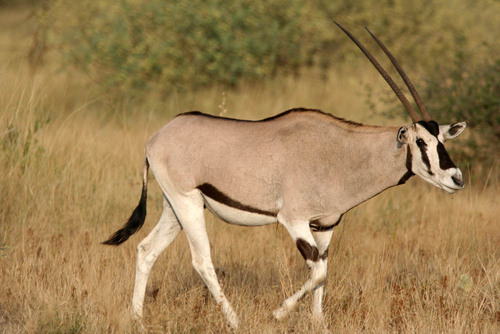
East African Oryx
Oryx beisa
With its rapier-like horns and striking monochrome mask, the East African Oryx is the ultimate desert survivor. Often called the 'Beisa,' this majestic antelope thrives where few others can, navigating the sun-scorched steppes of the Horn of Africa.
Quick Identification
Size
Height: 110-120 cm (43-47 in) at shoulder; Weight: 100-200 kg (220-440 lbs)
Colors
Sandy-grey or tan body with a white underbelly. Distinctive black-and-white facial mask and black stripes on the legs and flanks.
Key Features
- Long, straight, ringed horns up to 40 inches
- Bold black 'mask' across the eyes and muzzle
- Black stripe along the flank separating the back from the belly
- Fringe-eared subspecies has prominent hair tufts on the ear tips
When You’ll See Them
Geographic range
Where Does the East African Oryx Live?
Native to the Horn of Africa and the broader East African region, this species is primarily concentrated in the arid landscapes of Ethiopia, Somalia, and Kenya. The common beisa is found in the northern reaches, particularly north of the Tana River, while the fringe-eared subspecies occupies the southern grasslands of Kenya and northeastern Tanzania. Their range is increasingly fragmented, limited mostly to protected national parks and remote desert frontiers.
Basemap © OpenStreetMap contributors
Behavior
The East African Oryx is a highly social and resilient antelope, living in herds that typically range from 6 to 40 individuals. These groups are usually led by a dominant male, though a senior female often takes the lead when the herd is on the move. They are masters of the desert, possessing a unique physiological ability to raise their core body temperature to avoid sweating and conserve water during the blistering heat of the day.
These animals are generally wary of human presence, having been pushed into more remote regions due to competition with livestock and hunting. In the wild, they exhibit complex social hierarchies and territorial behaviors, often using their impressive, rapier-like horns for ritualized sparring rather than lethal combat. While they are primarily grazers, they are known to be nomadic, following the scent of distant rainfall to find fresh green shoots.
EverydayEarth exclusive
Camera Tips
Capturing the East African Oryx on a trail camera requires a strategic approach focused on water and movement corridors. Because these animals inhabit vast, open landscapes, placing cameras at random is rarely successful. Instead, focus on permanent water holes or seasonal 'pans' during the dry season. Position your camera approximately 3 to 4 feet (1 meter) off the ground to capture the full profile of the animal and its impressive horns. Since they are large and move with a steady gait, a standard trigger speed is acceptable, but high-quality video mode is recommended to capture their social interactions within the herd.
Lighting is your biggest challenge in their native habitat. To avoid 'white-out' images in the harsh midday sun, try to position cameras facing North or South to minimize direct lens flare. Use high-end 'No-Glow' infrared flash settings for night captures; even though they are primarily crepuscular, oryx move frequently under the cover of darkness to avoid predators like lions. If your camera is near a water source, the reflections can sometimes trigger the sensor prematurely, so adjust your sensitivity settings to 'Medium' to avoid a memory card full of empty frames.
Look for signs of their presence before mounting your gear. Oryx leave very distinct, heart-shaped tracks and often use 'dung middens' to mark their territory. If you find a concentrated area of droppings near a bush, this is an excellent spot for a camera. During the peak of the dry season, they are more predictable in their movements, making this the best time for photography. Ensure your camera housing is heat-resistant and well-secured, as curious young oryx or other wildlife may investigate the device.
Similar Species
Species that look similar or are commonly confused with East African Oryx.
Gemsbok
Larger with more extensive black markings on the rump and lower legs; found primarily in Southern Africa.
Scimitar-horned Oryx
Features curved, sword-like horns rather than straight ones, and has much paler, mostly white body coloration.
Arabian Oryx
Smaller and almost entirely white to reflect desert heat, with dark chocolate-colored legs.
Frequently Asked Questions
Record East African Oryx at your habitat
Connect a camera to start building your own species record — AI identifies every visitor automatically.