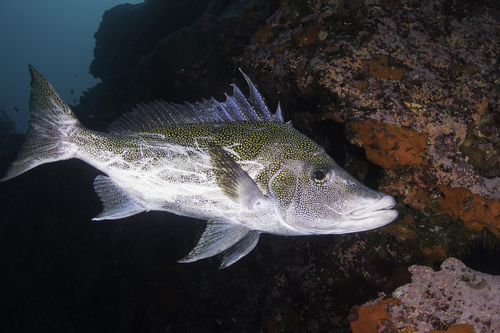
Giant Boarfish
Paristiopterus labiosus
The Giant Boarfish is an architectural marvel of the ocean, featuring a stunning 'armored' head and a specialized tubular snout. Found in the cool temperate waters of Australia and New Zealand, this striking striped fish is a prized find for underwater explorers.
Quick Identification
Size
Typically reaches 60–100 cm (24–39 in) in length; can weigh up to 12 kg (26 lbs)
Colors
Silvery-grey to pale brownish body with distinct dark brown or black diagonal bands; fins often have dark margins
Key Features
- Elongated, tube-like snout for crevice feeding
- Heavily armored head with bony plates
- High, sail-like dorsal fin with sharp spines
- Deep, compressed body with striking diagonal stripes
- Thick, fleshy lips used for suction feeding
When You’ll See Them
Geographic range
Where Does the Giant Boarfish Live?
Native to the temperate coastal waters of the Southern Hemisphere, the Giant Boarfish is most commonly found along the southern coastline of Australia, from the southwestern reaches of Western Australia to the shores of New South Wales and around Tasmania. This species is also a prominent inhabitant of the marine ecosystems surrounding both the North and South Islands of New Zealand. They are typically restricted to the continental shelf, thriving in the nutrient-rich, cooler waters of the Pacific and Indian Ocean intersections.
Basemap © OpenStreetMap contributors
Behavior
The Giant Boarfish is a relatively solitary and slow-moving species that spends most of its time hovering near the sea floor. They are known for their inquisitive but cautious nature; while they often approach divers out of curiosity, they are quick to retreat if they feel threatened. They are primarily demersal, meaning they live and feed near the bottom of the continental shelf, using their specialized snout to probe for food.
These fish are most active during daylight hours, relying on their keen eyesight to spot prey hidden in the sand or within rocky crevices. While they are not known for forming large schools, they are occasionally found in pairs or small groups, particularly during the breeding season. In the wild, they exhibit a calm temperament and are a favorite subject for underwater photographers due to their striking profile and unique swimming gait.
EverydayEarth exclusive
Camera Tips
Capturing the Giant Boarfish requires a stationary underwater camera setup, such as a Baited Remote Underwater Video (BRUV) system. Because this species resides at depths typically starting around 20 metres, you will need a waterproof housing rated for at least 40 metres to ensure safety and equipment longevity. Position your camera on the transition zone where rocky reef meets open sand, as Boarfish frequently patrol these 'edge' habitats to forage.
To attract a Giant Boarfish to your lens, use a mesh bait bag containing oily fish scraps or crushed mollusks. The scent trail is highly effective at drawing them out from reef crevices. Since light fades quickly as you descend, use wide-angle video lights with a high CRI (Color Rendering Index) to bring out the natural silvery-grey and deep brown tones of their stripes. Avoid using high-intensity strobes directly at their eyes, as they are sensitive to light and may flee.
Set your camera to a higher frame rate (60fps or higher) to capture the fluid, oscillating movement of their large dorsal and anal fins. Because they move slowly, a wide-angle lens is preferred to capture their entire body and the surrounding environment. Ensure your camera is weighted heavily or anchored to the seafloor to prevent surge and current from causing motion blur or tilting the frame.
Similar Species
Species that look similar or are commonly confused with Giant Boarfish.
Frequently Asked Questions
Record Giant Boarfish at your habitat
Connect a camera to start building your own species record — AI identifies every visitor automatically.